Last updated: April 2026
An AI HVAC answering service answers every call in under two seconds, triages emergencies using HVAC-specific logic, and books jobs directly into ServiceTitan, Housecall Pro, or Jobber — all for a flat monthly rate that doesn't spike during heat waves. Traditional call centers charge per minute, follow generic scripts, and can't tell the difference between a no-cool emergency and a routine filter change. For HVAC contractors losing $45,000–$120,000 a year to missed calls, the math is no longer close.
Last July in Phoenix, an HVAC owner walked off a rooftop at 4 PM and saw 14 missed calls on his phone. Three were the same homeowner — AC out, two kids, 108 degrees outside. By the time he called back, she had already booked someone else. That one missed call was worth $2,200.
This guide breaks down exactly where traditional HVAC answering services fall short, how AI answering services work differently, what they cost, and when a traditional service might still make sense.
How Much Revenue Do HVAC Companies Lose to Missed Calls?
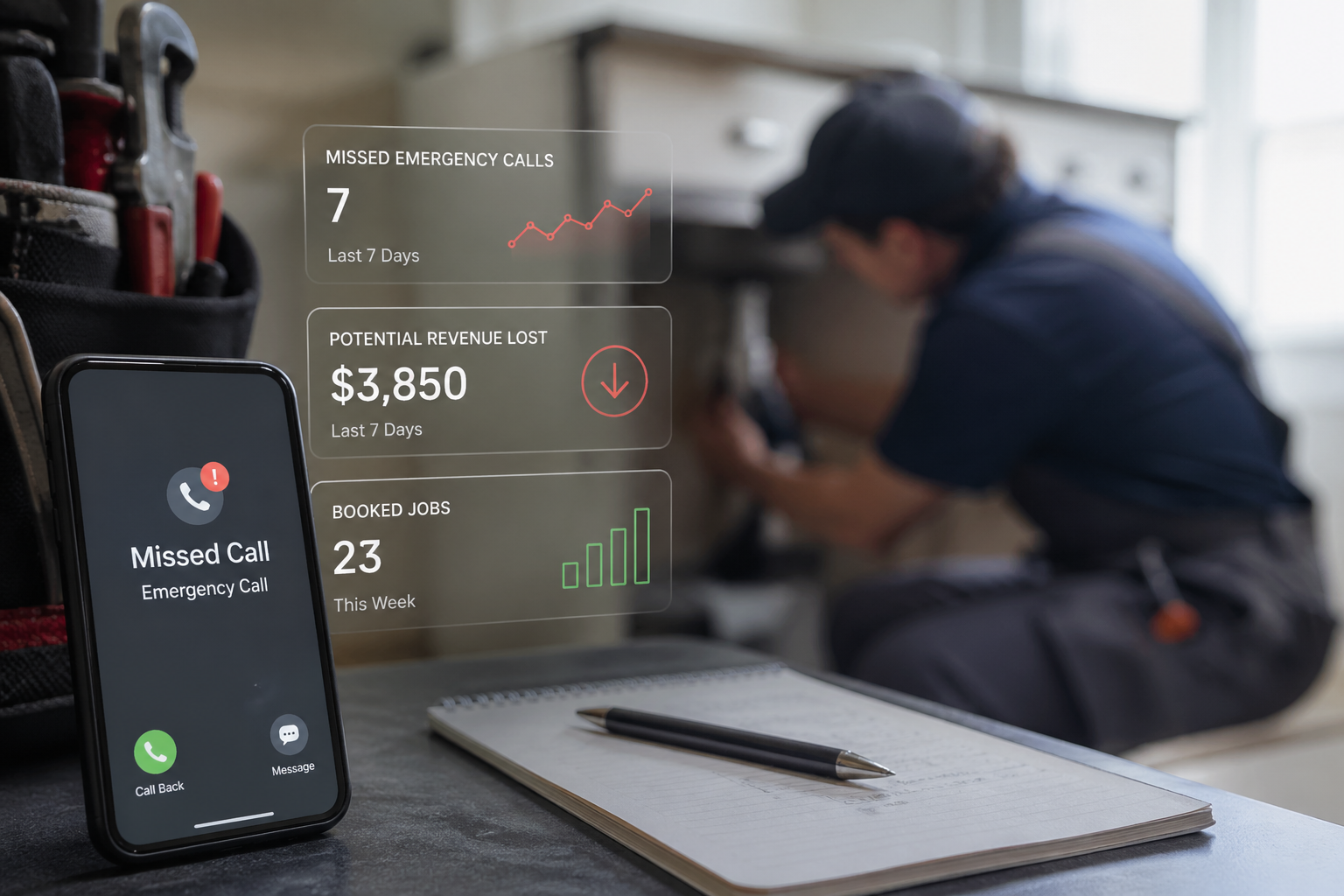
HVAC companies lose between $45,000 and $120,000 per year to unanswered phone calls, according to CallBird AI data from 1,200+ contractors across HVAC, plumbing, and electrical. The leaks are concentrated in the exact moments where HVAC margins are highest: emergency calls during heat waves, cold snaps, and after-hours windows.
Home services businesses miss roughly 27% of inbound calls on average, according to data published by Housecall Pro citing Invoca research. For an HVAC company taking 200 calls a month, that is 54 calls hitting voicemail or a busy signal every single month.
Those callers do not wait. Fewer than 3% of callers sent to voicemail leave a message, and an estimated 85% of unanswered callers never try a second time. They open Google, scroll one notch down, and call the next HVAC company on the list.
Invoca pegs the average value of a missed call to a home services business at around $1,200. For HVAC specifically, where emergency replacements run $4,000 to $8,000 and a furnace install can clear $10,000, the per-call exposure is even higher.
The leaks are concentrated exactly where HVAC margins are highest: emergency calls. After-hours, weekends, heat waves, cold snaps — the moments when a homeowner will pay a premium to whoever answers first are the same moments your techs are deepest in another job and least able to grab the phone.
Why Do Traditional HVAC Call Centers Fall Short?
Traditional HVAC answering services fail in three specific ways: per-minute billing that punishes peak season, generic operators who can't speak HVAC, and hold times that kill the highest-value calls. The model was built for an era when labor was cheap and HVAC owners didn't have a better option.
Per-minute billing punishes you when you need help most
Most traditional answering services charge $1.00 to $1.65 per minute, with overage fees once you exceed your monthly bucket. This is manageable in March. It is brutal in July when a heat wave triples your call volume in 48 hours. The bill that was supposed to be $300 a month becomes $900, and you find out about it three weeks later.
The whole point of having an answering service is that it covers you during the moments you cannot cover yourself. A pricing model that gets more expensive precisely when you need it most is working against you.
Operators do not speak HVAC
Most call center agents handle 30 different industries in a single shift. They are reading a script. They do not know the difference between a condenser, a compressor, and a capacitor. When a homeowner calls and says “the outside unit is humming but the inside is blowing warm air,” the operator writes down “AC issue” and moves on. Your tech shows up the next morning without the right parts.
Worse, generic operators cannot triage. Every call gets the same handling — name, number, brief description, callback. There is no logic that says “if the caller mentions no heat in winter, route this to the on-call tech in the next 5 minutes.” Emergencies and routine maintenance get the same treatment, and you find out which was which when you read the messages the next day.
Hold times kill the calls that matter most
Traditional services pool agents across many clients. During peak hours, that means hold queues. A homeowner whose furnace just died at 7 PM is not going to wait on hold for four minutes — they are going to hang up and dial the next contractor. The exact callers you most want to capture are the ones most likely to abandon a queue.
What Does an AI HVAC Answering Service Actually Do?
An AI HVAC answering service holds a real two-way phone conversation with callers, triages emergencies using HVAC-specific logic you define, and books jobs directly into your dispatch software — all without human involvement. It is not voicemail with a robot voice. It is a conversational AI trained on HVAC terminology that handles concurrent calls without limit.
The 3-Signal Triage Rule: how AI decides emergency vs routine
DialIQ's triage engine evaluates three signals on every HVAC call — a process we call the 3-Signal Triage Rule. This is what separates an AI receptionist from a generic answering service that treats every call identically.
Signal 1 — Language and urgency. The AI listens for HVAC-specific urgency indicators: “no heat,” “no cooling,” “elderly,” “baby in the house,” “water leaking from the unit,” “smell of gas.” It goes beyond keywords — “the outside unit is making a loud banging noise and something is dripping” gets classified as urgent without the caller using any technical term.
Signal 2 — Your business rules. You define what constitutes an emergency for your business. “No heat” in January is always emergency. “AC not cooling” in July is always emergency. “Filter replacement question” is routine booking. “Smell of gas” is immediate escalation. Your rules, not generic defaults.
Signal 3 — Instant routing. Emergencies route to your on-call tech in seconds — the caller hears “Let me connect you to a technician right now.” Routine calls get booked into your next available slot. Estimate requests get scheduled as consultations. No waiting, no voicemail, no callbacks.
That triage is the difference between a $180 routine service ticket and a $2,000 emergency replacement. Both calls came in. Only one becomes revenue today, and the AI decides which is which in real time — in under 5 seconds, while the customer is still on the line.
It picks up on the first ring, every time
There is no hold queue, no overflow routing, no “all agents are currently busy.” The AI answers concurrent calls without limit. If 40 people call your line during a heat wave hour, all 40 reach a live answer at the same time. This single change — from “sometimes answered” to “always answered” — is where most of the revenue recovery comes from.
Books jobs straight into your existing schedule
The AI integrates with the dispatch and CRM tools HVAC companies already run on — ServiceTitan, Housecall Pro, Jobber, and the major calendar systems. When a caller agrees to a 2 PM Wednesday slot, that slot is gone in your system before the call ends. No double-booking, no callback to confirm, no manual data entry the next morning. Everything the caller said is in the job notes when your tech rolls up.
See how DialIQ's AI receptionist handles call routing for home services contractors, from emergency dispatch to routine scheduling.
AI vs Traditional HVAC Answering Service: Side-by-Side Comparison
Here is what the comparison actually looks like across the dimensions HVAC owners care about most. The pattern is consistent: AI wins on coverage, triage, booking speed, and cost predictability.
| Feature | AI HVAC Answering | Traditional Call Center | Voicemail |
|---|---|---|---|
| Answers 24/7 | Yes, every call | Usually, with hold times | No live answer |
| Speaks HVAC | Trained on your services | Generic script | N/A |
| Emergency triage | Built-in, instant routing | Operator judgment | None |
| Books into calendar | Yes, in real time | Sometimes | No |
| Handles call spikes | Unlimited concurrent | Hold queue / overflow fees | No |
| Pricing model | Flat monthly | Per minute or per call | Free |
| Cost in busy season | Stays the same | Spikes | — |
| Setup time | Under an hour | Days to weeks | Instant |
| Caller experience | Natural conversation | Varies by operator | Most hang up |
The one place a traditional service still has an edge is the rare call where the homeowner is in genuine emotional distress and wants to be talked through it by a human voice — and even there, a hybrid setup that escalates the AI to a live agent on demand handles the situation without giving up everything else.
How Much Does an AI HVAC Answering Service Cost in 2026?
An AI HVAC answering service like DialIQ starts at $49 per month for 50 calls, with plans at $99/month (100 calls) and $499/month (600 calls). All plans include 24/7 coverage, unlimited concurrent calls, and flat-rate pricing that does not spike during peak season. For exact plan details, see the DialIQ pricing page.
Traditional answering services typically charge $250 to $600 a month for moderate volume, with per-minute overages that can push the bill much higher during heat waves and cold snaps. Hiring a full-time receptionist runs $38,000 to $50,000 a year before benefits, and a single receptionist still cannot answer two calls at once or work the after-hours window when most emergency revenue actually comes in.
The bigger number is what you stop losing. If you currently miss 30 calls a month and recover even half of them at the Invoca average of $1,200 per call, that is $18,000 in monthly revenue you are not capturing today. The math is laid out in detail in the missed call cost breakdown for home services companies.
How Do You Set Up an AI HVAC Answering Service?
Most HVAC companies are live within an hour and fully tuned within a week. The setup has four steps.
Step 1 — Forward your business line to the AI receptionist number, or set it to pick up only after hours and on overflow. You stay in control of when it answers.
Step 2 — Train the AI on your business: services offered, service area, pricing, brands you work on, and after-hours rates. Most providers let you upload your website or a document and the AI pulls the rest.
Step 3 — Define your emergency triggers: which keywords route to the on-call tech, which go to voicemail, which get booked into the next available slot. This is where the 3-Signal Triage Rule gets configured.
Step 4 — Connect your dispatch software so jobs flow into your calendar in real time. ServiceTitan, Housecall Pro, Jobber, or Google Calendar via Zapier. Test with a few calls from your own phone.
Compare that to onboarding a traditional answering service, which typically takes two to three weeks of script reviews and team training.
When Does a Traditional Answering Service Still Make Sense?
AI is not always the right call. If your business handles grief-stricken commercial property managers during active disasters, or if your client base skews toward elderly homeowners who genuinely struggle with anything that is not a human voice, a hybrid model with live human backup can be worth the extra cost.
A good AI answering service should give you the option to escalate to a person on demand rather than forcing you to choose one or the other. DialIQ offers exactly this — the AI handles the standard 95% of calls, and the edge cases get routed to your team or a human backup service.
For everything else — the after-hours emergency, the routine maintenance booking, the heat wave overflow, the lead capture from a Google ad click — a modern home services answering service powered by AI does the job better, faster, and at a flat cost that does not punish you for being busy.
Frequently Asked Questions About HVAC Answering Services
What is an HVAC answering service?
An HVAC answering service is a call handling solution that picks up the phone when your team cannot. It greets callers, captures their contact information, identifies whether the call is an emergency, and either books the job or routes the caller to your on-call technician. Traditional versions use human operators in a call center; modern versions use AI that holds a natural conversation and integrates directly with dispatch software like ServiceTitan, Housecall Pro, and Jobber.
How much does an AI HVAC answering service cost compared to a human receptionist?
A full-time HVAC receptionist runs roughly $38,000 to $50,000 a year and only covers business hours. An AI receptionist starts at $49/month, covers 24/7, and handles unlimited concurrent calls during peak season. The break-even on switching is usually within the first month. For detailed pricing, see the DialIQ pricing page.
Can an AI answering service handle HVAC emergency calls?
Yes, when set up correctly. A purpose-built AI receptionist is trained to recognize HVAC emergency keywords — no heat, no cooling, water leak, gas smell, elderly resident — and route those calls to your on-call tech immediately, while booking routine requests into your normal schedule. The triage logic is something you define using the 3-Signal Triage Rule.
Will my customers know they are talking to an AI?
Modern AI voice agents sound natural enough that most callers do not flag it as artificial, especially during a quick service call. The bigger reaction from homeowners is relief that someone picked up at all. If a caller specifically asks for a human, a well-configured AI will offer to take a message and notify you immediately or transfer the call to your team.
How is this different from a traditional after-hours answering service?
A traditional after-hours answering service uses human operators reading a generic script, charges per minute, and routes urgent calls based on operator judgment. An AI answering service answers in under a second, uses HVAC-specific triage logic you control, charges a flat monthly rate, and books appointments directly into your calendar without a callback.
Does an AI HVAC answering service work for plumbers, electricians, and other trades?
Yes. The same triage logic that works for HVAC works for any home services use case — plumbing leaks, electrical outages, roofing storm damage. The AI receptionist for home services guide covers the broader category, and sub-pages for plumbing, electricians, and roofing cover each trade specifically.
Is there a free AI answering service for HVAC companies?
Most AI answering services offer free trials but not permanent free tiers. DialIQ offers a 14-day free trial with no credit card required. The Essential plan starts at $49/month, which is less than the cost of a single missed emergency call for most HVAC businesses.
Stop letting heat waves and after-hours calls walk away
Every missed HVAC call has a real dollar value. An AI answering service is the cheapest way to fix the leak — no hiring, no per-minute fees.
Sources: Invoca home services missed call research; Housecall Pro analysis of inbound call data; CallBird AI contractor study (1,200+ contractors).