You've decided to implement AI reception. Smart move—you're about to capture hundreds of thousands in revenue currently going to voicemail or competitors. But like any powerful tool, AI reception delivers maximum value when implemented strategically. This playbook provides step-by-step guidance for HVAC, plumbing, roofing, pool service, and pest control companies to deploy, optimize, and scale AI phone coverage for maximum ROI.
Phase 1: Pre-Implementation (Week Before Deployment)
Before your AI receptionist answers its first call, strategic preparation determines success. Most contractors skip these steps and end up with suboptimal performance.
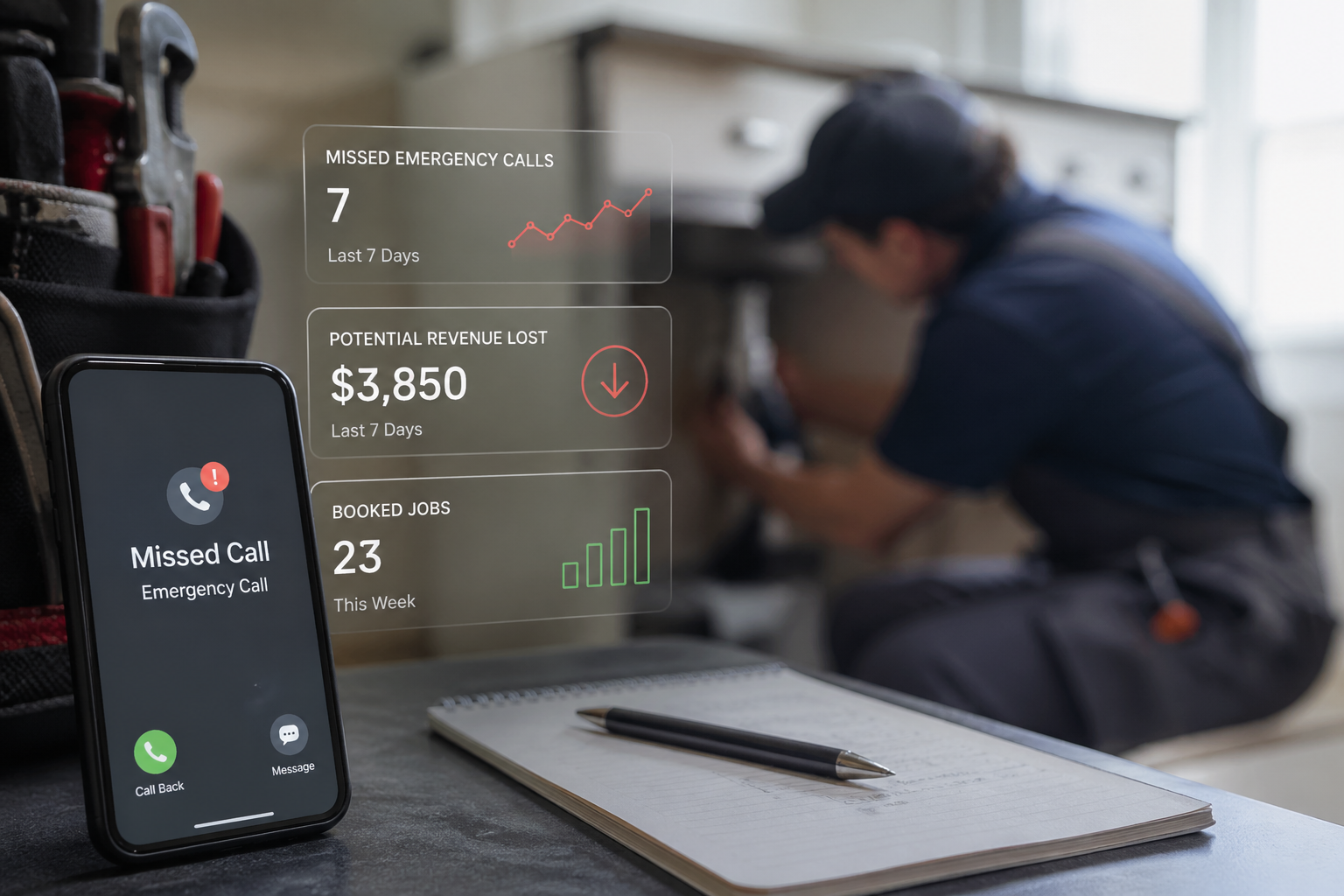
Step 1: Conduct Your Phone Coverage Audit. You can't improve what you don't measure. Establish baselines before AI implementation so you can demonstrate ROI. Track for 2-4 weeks: Total incoming calls (by hour, day, and week). Calls answered vs. missed (require call tracking system or phone system data). Average time to answer. Call duration average. Conversion rate (calls to booked appointments). After-hours call volume. Seasonal patterns if available.
This baseline data proves ROI and identifies your biggest opportunity areas. Often contractors discover they're missing more calls than they realized.
Step 2: Document Your Current Call Handling Processes. AI learns from your existing best practices. Create detailed documentation including: Standard call scripts for common scenarios (service calls, emergency calls, routine maintenance inquiries, new customer inquiries, existing customer follow-ups). Emergency triage protocols (what constitutes an emergency vs. urgent vs. routine). Pricing and estimation guidelines (when to provide quotes, ranges vs. exact pricing, when to defer to in-person assessment). Service area boundaries and response times. Scheduling rules (minimum appointment lengths, technician specializations, geographic routing). Upsell and cross-sell protocols (when to suggest additional services). Guarantee and warranty explanation.
Don't have documented processes? Recording a few experienced receptionists or yourself handling typical calls provides the foundation AI needs.
Step 3: Clean Your Tech Stack. AI integration works best with clean, organized data in your field service software. Before AI deployment: Audit customer data for duplicates and errors. Standardize data entry (consistent address formats, phone numbers, service categories). Confirm your field service software subscription includes API access for integration. Identify team members who'll manage AI system and grant appropriate access. Review technician calendars and ensure availability is accurately reflected.
Clean data prevents AI from booking appointments based on outdated information or creating duplicate customer records.
Step 4: Define Success Metrics and Goals. Establish clear targets so everyone knows what success looks like. Common metrics: Call answer rate target (realistic: 98%+). Conversion rate target (realistic: 55-70% depending on trade and call type). After-hours appointment booking target. Customer satisfaction score maintenance (AI should equal or exceed human CSAT). Cost reduction from eliminating or reducing answering service. Revenue increase from captured calls.
Share these metrics with your team so everyone understands AI's purpose is revenue growth and customer experience improvement, not staff replacement.
Step 5: Communicate with Your Team. Your human receptionists could view AI as a threat. Frame it as augmentation, not replacement. Key messages: AI handles overflow and after-hours, allowing receptionists to focus on complex customer service. Receptionist roles evolve to managing AI, handling escalations, and building relationships. Job security improves because business growth creates opportunities. AI eliminates the frustrating parts of their job (repetitive questions, being overwhelmed during peaks).
Include receptionists in AI training process—their expertise improves AI performance and gives them ownership of the tool.
Phase 2: Implementation (Weeks 1-4)
With preparation complete, implementation follows a proven progression from low-risk pilot to full deployment.
Week 1: Onboarding and Initial Configuration. Your AI provider conducts comprehensive onboarding (typically 60-90 minutes) to: Record sample conversations with you or lead receptionist demonstrating ideal call handling. Document your call handling protocols. Integrate with field service software (ServiceTitan, Jobber, Housecall Pro, etc.). Configure emergency triage rules specific to your trade. Set up call routing logic (when AI handles calls, when it escalates to humans). Customize AI voice, personality, and communication style to match your brand. Program service area boundaries and scheduling parameters.
At this stage, don't aim for perfection—aim for good enough to start learning. AI improves fastest through real customer interactions.
Week 1: Parallel Testing. Before deploying to customers, test AI with internal calls. Have team members roleplay various customer scenarios including: Standard service requests. Emergency situations requiring immediate dispatch. Complex multi-issue calls. Pricing and estimation questions. Schedule changes and cancellations. Upset or frustrated customers.
Record these calls and review as a team. Identify gaps, refine scripts, and ensure AI handles your most common scenarios effectively. This internal testing builds team confidence before customer deployment.
Week 2: Low-Risk Pilot (After-Hours Only). Deploy AI for the lowest-risk, highest-opportunity scenario—after-hours calls. Route all calls outside business hours (evenings, nights, weekends) to AI. Maintain your existing answering service as backup initially. Monitor every call recording and transcript daily. Track conversion rates and customer feedback.
Why start after-hours: Lower call volume allows detailed quality review. Customer expectations are lower (happy to reach anyone vs. voicemail). Financial risk is minimal (you're likely capturing 15-25% of these calls currently). After-hours performance proves AI capability to skeptical team members.
Week 2: Rapid Iteration. Based on pilot calls, make daily refinements. Common adjustments: Script language that's too formal or too casual. Emergency keywords that aren't triggering proper triage. Pricing ranges that are inaccurate or confusing. Integration bugs with scheduling. Questions AI doesn't have good answers for.
Leading AI platforms allow real-time script updates without technical knowledge. Make changes immediately based on call performance.
Week 3: Expand to Business Hours Overflow. Once after-hours performance is strong, expand AI to handle overflow during business hours. Routing logic: Calls answered by human receptionist during normal capacity. When both receptionists are on calls, route to AI. When call volume exceeds human capacity, route to AI.
This hybrid approach lets humans handle calls when they're available while AI captures overflow that would otherwise become missed calls or voicemail.
Week 3: Team Training on AI Management. Train your team on: Reviewing call recordings and transcripts in AI dashboard. Identifying patterns that need script adjustments. Managing AI escalations when customers request human assistance. Using analytics to track performance metrics. Updating AI knowledge base when services, pricing, or policies change.
Your team should view AI as a tool they manage, not a mysterious black box.
Week 4: Full Deployment Decision. After 3 weeks of pilot and overflow testing, decide on full deployment. Most contractors choose one of three models: Hybrid Model: AI handles after-hours and overflow, humans handle first-line calls during business hours. Full AI Model: AI handles all calls; humans take escalations and manage AI. Best for scaling efficiency. Full Human with AI Backup: Humans handle calls when available; AI covers breaks, lunch, end-of-day, etc.
There's no single right answer—choose based on your team, business model, and growth plans. You can always adjust later as you gain confidence.
Phase 3: Optimization (Months 2-6)
With AI deployed, focus shifts from implementation to optimization. Small improvements compound to significant performance gains.
Strategy 1: Weekly Performance Review Ritual. Establish a weekly 30-minute meeting to review AI performance. Review dashboard metrics (calls handled, conversion rates, average call duration, customer satisfaction, escalation rate). Listen to 5-10 sample calls (randomly selected, plus any flagged by team). Identify patterns in customer questions AI handles poorly. Review schedule to update AI's scripts and knowledge base. Track progress toward success metrics defined in Phase 1.
This ritual ensures continuous improvement and catches issues before they become patterns.
Strategy 2: A/B Test Scripts and Approaches. Run controlled experiments to optimize conversion. Test variations: Call greeting style (formal vs. casual vs. personalized). Order of information gathering (qualify urgency first vs. collect contact info first). Pricing communication (ranges vs. deferred to in-person). Upsell timing (beginning of call vs. end). Confirmation method (text vs. email vs. both).
Change one variable at a time, measure results over 1-2 weeks, and implement winning approaches.
Strategy 3: Build AI's Knowledge Base Continuously. As customers ask questions AI can't answer perfectly, expand its knowledge base. Common additions: Specific service explanations (how does duct cleaning work, what's involved in water heater replacement). Parts and equipment brands you service or install. Warranty details and coverage terms. Seasonal service recommendations. Financing options and payment plans. Common DIY troubleshooting steps.
Think of AI's knowledge base as a living document that grows richer over time.
Strategy 4: Optimize Emergency Triage Accuracy. Review every emergency escalation to ensure triage accuracy. If AI over-escalates (flags non-emergencies as urgent), refine emergency indicators to be more specific. If AI under-escalates (misses true emergencies), add keywords and contextual signals. Goal: 95%+ accuracy in emergency identification.
This protects your brand (genuine emergencies get immediate response) and your profitability (non-emergencies don't trigger expensive after-hours dispatch unnecessarily).
Strategy 5: Integrate Outbound Calling Campaigns. Once inbound call handling is optimized, leverage AI for proactive outreach. Effective campaigns: Maintenance agreement renewals (30 days before expiration). Seasonal service promotions (HVAC tune-ups before summer/winter). Post-service follow-up and review requests. Equipment replacement recommendations (aging water heaters, AC units). Appointment confirmations and reminders.
Outbound campaigns dramatically increase revenue per customer while reducing no-shows.
Strategy 6: Mine Call Data for Business Intelligence. AI captures every customer interaction. Use this data strategically. Analyze: Common customer complaints indicating service issues. Seasonal patterns to predict staffing needs. Competitive mentions (customers shopping around). Price objections suggesting pricing adjustments. Upsell opportunities being missed by technicians. Marketing attribution (which channels generate calls that convert).
This intelligence drives better decisions across operations, pricing, and marketing.
Phase 4: Scaling (Months 6+)
With AI optimized, scale the advantage across your entire operation and growth plans.
Scaling Strategy 1: Geographic Expansion. Opening new service areas? AI scales instantly without hiring. Add service area boundaries to AI configuration. Update technician routing and scheduling. Deploy same optimized scripts and protocols. No recruitment, training, or incremental cost.
AI removes the administrative bottleneck that typically constrains geographic expansion.
Scaling Strategy 2: Additional Service Lines. Adding new services (HVAC company adds plumbing, roofing company adds gutters)? Train AI on new service offerings. Update pricing and estimation protocols. Add new upsell logic. Deploy immediately without hiring specialized staff.
Many contractors delay adding services because administrative complexity increases. AI makes diversification operationally simple.
Scaling Strategy 3: Multi-Location Consistency. Growing beyond single location? AI ensures consistent customer experience across all locations. Configure location-specific details (hours, service areas, technician availability). Maintain consistent brand voice and quality. Centralize analytics across all locations. Share optimizations instantly.
Franchise-quality consistency without franchise-level administrative overhead.
Scaling Strategy 4: Technician Efficiency Optimization. Use AI to maximize technician productivity. Real-time schedule optimization: AI automatically offers earlier appointments when technicians finish jobs ahead of schedule. Same-day appointment filling: AI calls customers with non-urgent needs when same-day slots open. Route optimization: AI books appointments geographically to minimize drive time. Pre-appointment intelligence: Technicians arrive with complete customer history, equipment details, and service expectations already collected.
Scaling Strategy 5: Customer Lifetime Value Maximization. Deploy AI to systematically increase value from every customer relationship. Automated maintenance reminders at optimal intervals. Systematic upselling and cross-selling based on service history. Proactive equipment replacement recommendations. Referral request automation after positive service experiences. Win-back campaigns for customers who haven't called in 12+ months.
AI turns every customer relationship into a systematic revenue stream rather than one-time transactions.
Advanced Tactics: Getting the Most from AI Reception
For contractors ready to extract maximum value, these advanced tactics deliver outsized results.
Advanced Tactic 1: Seasonal Script Optimization. Don't use the same scripts year-round—adapt to seasonal customer needs. HVAC example: Spring (emphasize AC tune-ups before summer heat), summer (emergency AC repair urgency, premium pricing for high demand), fall (furnace maintenance before winter), winter (emergency heat repair urgency, insulation and efficiency upgrades).
Seasonal optimization increases conversion by aligning messaging with customer urgency and mindset.
Advanced Tactic 2: Customer Segmentation. Treat different customer segments differently. New customers: Emphasize guarantees, credentials, and trust-building. Existing customers: Reference service history, offer loyalty incentives. High-value customers: Fast-track scheduling, offer premium service options. Price-sensitive customers: Emphasize financing options and payment plans.
AI can identify segment based on phone number lookup in your system and adjust approach accordingly.
Advanced Tactic 3: Dynamic Pricing Communication. Don't quote fixed prices—communicate pricing based on demand and urgency. Peak demand periods: Communicate premium pricing honestly ("Due to high demand during heat waves, emergency service includes surge pricing. Next available standard rate appointment is in 3 days."). Low demand periods: Offer incentives ("We have availability tomorrow and are offering 15% off maintenance this week.").
Dynamic pricing maximizes revenue during peaks while filling capacity during valleys.
Advanced Tactic 4: Competitor Intelligence Tracking. Program AI to flag and document competitive mentions. When customers say they're calling multiple companies or mention specific competitors, AI captures: Which competitors are mentioned most frequently. Price points competitors are quoting. Service issues customers are experiencing with competitors. Reasons customers are leaving competitors.
This intelligence informs competitive strategy and positioning.
Advanced Tactic 5: Review and Referral Automation. Use AI to systematically generate reviews and referrals. Post-service call workflow: 24 hours after service, AI calls to confirm satisfaction. If customer is satisfied (9-10/10), AI requests online review and sends link via text. 48 hours later if review not left, AI follows up once more. For extremely satisfied customers, AI asks for referrals and offers incentive.
This systematic approach generates consistent review flow that compounds online reputation over time.
Common Pitfalls to Avoid
Even with strategic implementation, contractors make predictable mistakes. Avoid these.
Pitfall 1: Over-complicating initial setup. Don't try to program AI for every possible scenario before launching. Deploy with 80% confidence on common scenarios. Learn and iterate quickly through real customer calls. Perfect is the enemy of good enough to start learning.
Pitfall 2: Under-investing in ongoing optimization. Implementation is not "set it and forget it." Schedule weekly performance reviews. Continuously refine scripts and knowledge base. Test variations to improve conversion. Treat AI as a tool requiring active management, not passive technology.
Pitfall 3: Failing to integrate feedback loops. AI improves fastest when teams regularly review calls and provide feedback. Establish clear process for team members to flag issues. Review flagged calls and make adjustments quickly. Share improvements across the team so everyone learns.
Pitfall 4: Neglecting customer communication. Some customers will prefer human interaction. Always provide easy escalation paths. Don't hide that you use AI if customers ask directly. Emphasize benefits (24/7 availability, immediate response) not the technology.
Pitfall 5: Limiting AI to phone coverage only. AI can handle text/SMS, email, and chat—don't limit to voice. Deploy omnichannel AI for consistent experience across all communication methods. Integrate everything with your CRM/field service software.
Measuring Success: The Metrics That Matter
Track these KPIs monthly to quantify AI's business impact. Call performance metrics: Answer rate percentage (target: 98%+). Average time to answer (target: under 10 seconds). Call abandonment rate (target: under 2%). Conversion rate (calls to booked appointments, target: 55-70%).
Financial metrics: Revenue from AI-handled calls. Cost per booked appointment (AI cost divided by appointments booked). Revenue per call. ROI (additional revenue minus AI cost divided by AI cost).
Customer experience metrics: Customer satisfaction score (target: 8.0+/10). Escalation rate (calls requiring human intervention, target: under 5%). Complaint rate specifically about AI. Net Promoter Score (are customers likely to refer?).
Operational metrics: No-show rate (AI reminder effectiveness). Average appointment lead time. Technician utilization rate (well-booked schedule percentage). Staff time spent on phone tasks (should decrease with AI).
The Continuous Improvement Mindset
AI reception is not a one-time technology implementation—it's an ongoing strategic advantage that compounds over time. Companies that extract maximum value treat AI as a continuously improving asset. They review performance weekly, test new approaches monthly, expand AI's capabilities quarterly, and share learnings across teams constantly.
Your AI receptionist in Month 12 should be dramatically more effective than in Month 1—not because the underlying technology changed, but because you've systematically optimized it based on thousands of customer interactions.
Your Next Steps
You now have the complete playbook for implementing, optimizing, and scaling AI reception in your home services business. The contractors who capture market share and maximize ROI follow this strategic approach rather than treating AI as "plug and play" technology.
Ready to begin? Start with Phase 1 this week—conduct your phone coverage audit, document current processes, and establish baseline metrics. Then schedule a demo with DialIQ to see how our home-services-specific AI platform handles your exact call scenarios.
The playbook gives you the strategy. DialIQ gives you the tool. Your execution determines the results. Let's get started.