Why AI Voice Assistants Are Changing Business Operations
An AI voice assistant is a software application powered by artificial intelligence that understands spoken commands and responds naturally through voice. These assistants can:
- Handle customer calls 24/7 without human intervention
- Schedule appointments and manage bookings automatically
- Answer frequently asked questions instantly
- Qualify leads and collect customer information through natural conversation
- Integrate with existing business tools like CRMs, calendars, and databases
- Route complex queries to human agents when needed
Remember when voice assistants were just glorified alarm clocks? Those days are gone.
AI voice assistants have evolved from novelty gadgets that could barely set a timer into sophisticated business tools that handle complex conversations, automate workflows, and never miss a customer inquiry. The shift has been dramatic—and necessary. 42% of executives report that administrative work is their biggest time sink, and businesses can't afford to miss calls, lose leads, or keep customers waiting.
The market has split into two distinct camps. On one side, you have personal helpers like Siri and Alexa—great for playing music or checking the weather. On the other side, you have specialized business agents built to handle customer support, book appointments, qualify leads, and integrate with your existing systems.
For service-based businesses drowning in phone calls, the difference matters. A lot.
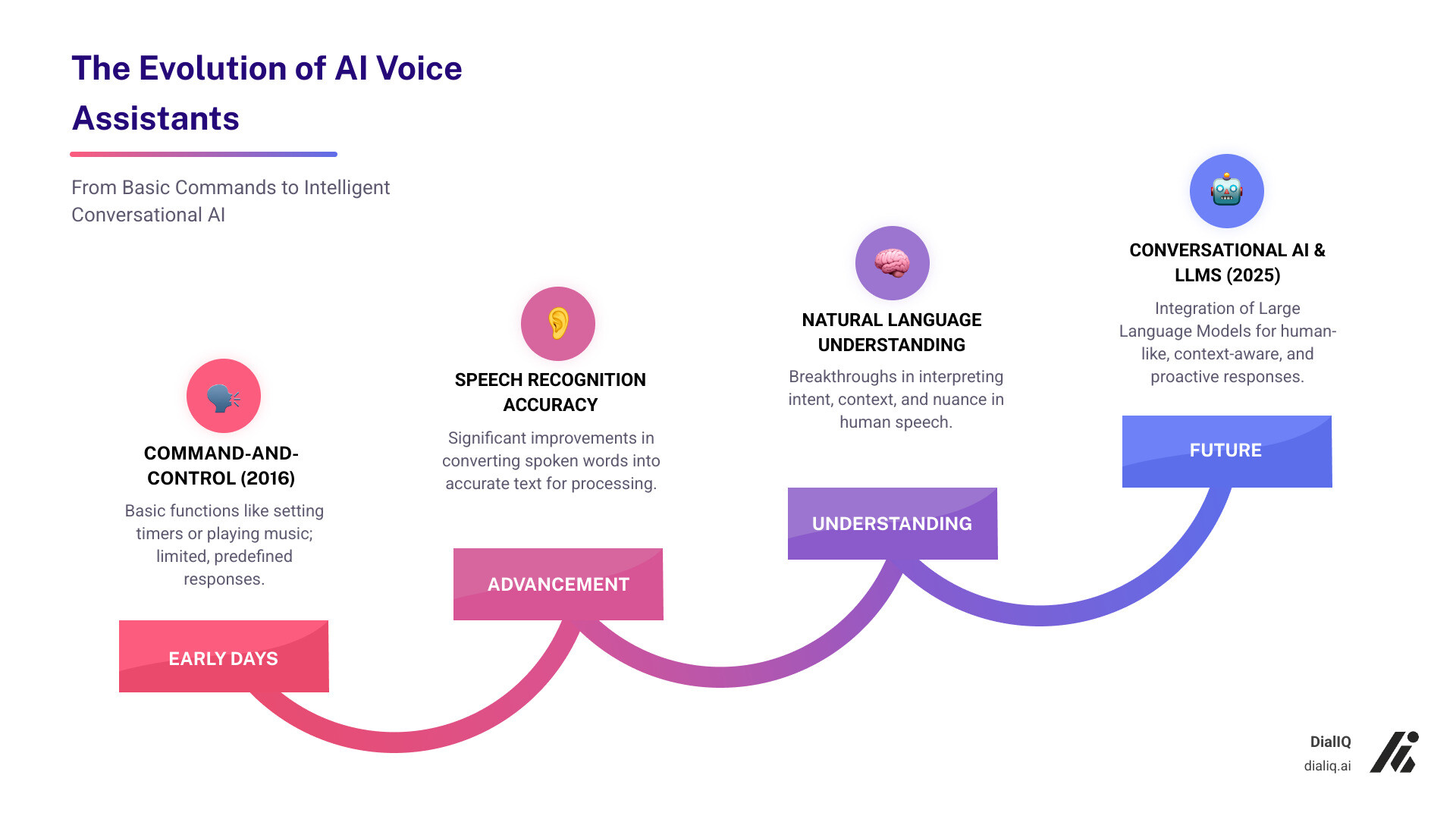
The technology behind these assistants has improved dramatically. Modern AI voice assistants use automatic speech recognition (ASR) to convert speech to text, natural language processing (NLP) to understand intent, and large language models (LLMs) to generate human-like responses. Workers using generative AI are saving 5.4% of their work hours per week, and productivity in AI-exposed industries has nearly quadrupled since 2018.
I'm Shaunak, and I'm building DialIQ—an AI voice assistant that answers every business call 24/7 for service-based companies across 40+ industries. I've seen how the right AI voice assistant can transform overwhelmed businesses into well-oiled operations that never miss an opportunity.
How AI Voice Assistants Understand and Respond
At its heart, an AI voice assistant is a marvel of interconnected technologies that work together to mimic human conversation. We speak, it listens, it understands, and it responds—all in a matter of milliseconds. This seemingly magical interaction relies on a few core technologies:

Automatic Speech Recognition (ASR): This is the first step, where our spoken words are converted into text. Imagine your voice as a complex waveform. ASR systems analyze these sound waves, breaking them down into phonemes (the smallest units of sound that distinguish one word from another). Using sophisticated machine learning algorithms, like the Hidden Markov Model, the system predicts what was said, changing the audio into a written transcript. The accuracy of ASR has dramatically improved, allowing AI voice assistants to understand diverse accents, speaking styles, and even filter out background noise.
Natural Language Processing (NLP): Once our speech is transcribed into text, NLP kicks in. This is where the AI voice assistant interprets the meaning and intent behind our words, not just the words themselves. NLP helps the assistant understand the structure of our sentences, recognize keywords, and extract crucial information from our requests. For example, if we say, "Schedule a meeting for next Tuesday at 2 PM with John," NLP identifies "schedule a meeting" as the intent, "next Tuesday at 2 PM" as the time, and "John" as the participant. This is a complex field, and DeepLearning.AI offers great insights into its nuances.
Large Language Models (LLMs): The recent explosion in AI capabilities owes much to LLMs. These advanced neural networks, trained on vast amounts of text data, enable AI voice assistants to generate coherent, contextually relevant, and human-like responses. LLMs allow for more natural, free-flowing conversations, moving beyond rigid command-and-response structures. They can summarize dense topics, draft content, and even engage in creative brainstorming, making interactions feel less like talking to a machine and more like talking to an intelligent partner.
Machine Learning and AI: These are the overarching forces that enable continuous improvement. AI voice assistants aren't static; they learn from every interaction. By analyzing past conversations, they get better at recognizing patterns, understanding subtleties, and handling increasingly complex requests. This iterative learning process is what makes them truly "intelligent" and adaptable. The more data they process, the smarter and more efficient they become.
Text-to-Speech (TTS) Synthesis: Finally, after processing our request and formulating a response, TTS technology converts the AI's generated text back into natural-sounding speech. Modern TTS systems use advanced neural networks to create highly realistic and emotionally expressive voices, often with customizable tones and even multilingual capabilities, ensuring a smooth and pleasant user experience.
These technologies combine to create a seamless conversational experience, allowing AI voice assistants to move beyond simple commands and engage in truly helpful, nuanced interactions.
Personal Helpers vs. Business Powerhouses: A Clear-Cut Divide
The landscape of AI voice assistants has clearly bifurcated into two main categories, each serving distinct purposes and user needs. On one side, we have the familiar personal helpers designed for individual convenience. On the other, we see the rise of specialized business powerhouses, engineered to drive efficiency and growth.

The Everyday Personal AI Voice Assistant
These are the AI voice assistants we've grown accustomed to in our daily lives—the ones that live in our smartphones, smart speakers, and other consumer devices. They are fantastic for:
- Smart Home Control: Asking your smart speaker to turn off the lights or adjust the thermostat is second nature for many of us. These assistants excel at integrating with many different platforms, tools, and devices to manage our smart home ecosystems, like connecting with smart home security systems.
- Personal Tasks: Setting reminders, making calls, sending texts, and checking the weather are bread and butter for these assistants. They are often seamlessly integrated with the device's operating system for tasks like setting alarms or navigating via map applications.
- Information Retrieval: Need a quick fact, a recipe, or the latest news? These assistants can pull up information from the internet or read out summaries.
- Entertainment: Playing music, audiobooks, or podcasts from various streaming services is a common use case. Some even offer fun skills, from guided meditations to games and interactive stories for kids, and even productivity hacks.
- Ecosystem Integration: These assistants are typically designed to operate within their own "little worlds" (think of the major tech ecosystems). They tie everything together within their respective apps and services.
While incredibly convenient for individual use, these personal AI voice assistants aren't truly designed to connect with the complex, often proprietary, systems that businesses rely on. They aren't built to learn from your company's specific data or integrate with your customer relationship management (CRM) software.
The Specialized Business AI Voice Assistant
This is where the real power for organizations lies. Specialized business AI voice assistants are purpose-built to tackle the unique challenges of commercial operations. Unlike their consumer counterparts, these agents are designed to:
- Automate Customer Support: Imagine an AI voice assistant handling routine inquiries, providing instant answers, and resolving common issues 24/7. This dramatically reduces the workload on human agents and ensures customers always get a response. We've seen businesses cut customer service expenses by 50% through automated responses.
- Streamline Lead Generation: An AI voice assistant can engage with potential clients, answer initial questions, qualify leads based on predefined criteria, and even schedule follow-up calls or demos directly into your sales team's calendar. This ensures no lead is ever missed, boosting conversion rates. For example, businesses can lift sales by 35% by seamlessly guiding users.
- Optimize Internal Operations: Beyond external customer interactions, these assistants can support internal teams. They can help with scheduling, provide quick access to internal knowledge bases, assist with data entry, and streamline onboarding processes. Voice-driven tutorials can improve learning curves by 45% for new hires.
- Deep API Integration: A critical differentiator is their ability to integrate deeply with existing business software. This means connecting with CRMs, enterprise resource planning (ERP) systems, scheduling platforms, and more, allowing for seamless data flow and automated actions.
- Customization and Personalization: Business AI voice assistants can be custom to a company's specific needs, brand voice, and industry-specific terminology. They can be trained on proprietary data to provide highly accurate and relevant information. This personalized interaction can lead to a 40% increase in customer satisfaction and retention.
- Scalability: They can handle fluctuating call volumes without needing additional human staff, ensuring consistent service during peak times or rapid growth.
- Improved Accessibility: By offering voice-driven interfaces, these assistants can improve accessibility for users with disabilities and enable use during physical activities, potentially increasing engagement with apps by 30%.
The distinction is clear: while personal assistants improve individual convenience, business-focused AI voice assistants are strategic assets that drive tangible improvements in efficiency, customer experience, and profitability. We believe the future of business communication relies heavily on these specialized agents.
Key Benefits of AI Voice Assistants for Business
The integration of AI voice assistants into business operations is no longer a futuristic concept; it's a present-day reality delivering measurable benefits. These intelligent agents are fundamentally reshaping how businesses interact with customers and manage internal workflows.
Drive Revenue and Customer Satisfaction
For customer-facing roles, a well-implemented AI voice assistant can be a game-changer for your bottom line and your reputation.
- Increased Conversion Rates: By providing instant, accurate information and guiding potential customers through sales funnels, AI voice assistants can significantly boost conversions. Imagine a customer calling with a question about a product or service; an AI can answer immediately, address concerns, and even help complete a purchase. Studies show that they can lift sales by 35% by seamlessly guiding users, reducing drop-offs, and driving more successful transactions.
- Improved Customer Satisfaction and Retention: Personalized and efficient interactions are key to happy customers. AI voice assistants can offer consistent, polite, and informed support 24/7, leading to a much smoother customer journey. Utilizing personalized voice interactions can foster stronger customer relationships, leading to a 40% increase in customer satisfaction and retention. Customers appreciate quick resolutions and feeling understood.
- Boosted User Engagement: Dynamic interfaces that respond instantly and intelligently keep users engaged. Whether it's within an app or on a website, an AI voice assistant can make interactions more intuitive and enjoyable. This can boost user engagement by an impressive 55%, enhancing retention and overall satisfaction levels.
- Improved Product Accessibility: AI voice assistants make products and services more accessible. For users with disabilities, or those engaged in physical activities like driving or cooking, voice interfaces offer a hands-free way to interact. This can increase time spent on your Apps by 30% by making them usable in more contexts.
Improve Operational Efficiency
Beyond direct revenue, AI voice assistants are powerful tools for optimizing internal processes and reducing operational overhead.
- Reduced Customer Service Costs: Automating responses to common queries and handling routine tasks frees up human agents to focus on more complex issues. This strategic reallocation of resources can cut customer service expenses by 50% through automated responses and proactive actions.
- Significant Time Savings: Administrative tasks can be a major drain on employee time. By automating scheduling, data entry, and information retrieval, AI voice assistants free up valuable hours. A study found that workers using generative AI saved 5.4% of their work hours in a week. Across all workers (including non-users), this translated to about 1.4% of total hours saved.
- Accelerated Onboarding and Training: Voice-driven tutorials can guide new employees or users through complex systems, helping them grasp functionality quickly. This can improve learning curves by 45%, getting new team members productive faster.
- Overall Productivity Boost: The impact on productivity is substantial. Globally, productivity growth has nearly quadrupled in industries most exposed to AI (e.g., financial services, software publishing), rising from 7% from 2018-2022 to 27% from 2018-2024. This highlights the transformative potential of AI voice assistants in enhancing efficiency across various sectors.
By strategically deploying AI voice assistants, businesses can achieve a powerful combination of increased customer satisfaction and streamlined operations, paving the way for sustainable growth.
Choosing the Right Business AI Voice Assistant
Selecting the ideal AI voice assistant for your business is a strategic decision that requires careful consideration of its features, capabilities, and how it aligns with your operational needs. It's not just about finding the "smartest" one; it's about finding the one that integrates seamlessly into your workflow and helps you achieve your specific goals.
Here are the most important features to consider:
Core Features and Integration
- Integration Capabilities: A business AI voice assistant is only as powerful as its ability to connect with your existing ecosystem. We look for robust API-native design that allows for extensive configuration and seamless integration with your CRM, scheduling software, internal databases, and other essential business tools. This ensures data flows smoothly and the AI can perform actions across your platforms.
- Automation Capabilities: Beyond answering questions, a true business AI voice assistant should automate tasks. Can it book appointments, update customer records, send follow-up emails, or qualify leads based on conversational cues? These automation capabilities are crucial for realizing significant efficiency gains.
- Customization Options: Your business is unique, and your AI voice assistant should reflect that. Look for platforms that allow you to customize the assistant's personality, tone of voice, and responses. The ability to bring your own models (e.g., for transcription, LLM, text-to-speech) offers unparalleled control and optimization.
- Tool Calling: Advanced AI voice assistants leverage "tool calling" capabilities. This means they can intelligently decide when to use external APIs to fetch real-time data or perform specific actions. For example, an AI could "call" your scheduling API to check availability or your CRM API to retrieve customer history during a call.
- Multilingual Support: In today's global market, serving a diverse customer base is paramount. A top-tier AI voice assistant should be able to handle multilingual interactions with ease, understanding and responding in multiple languages. Some platforms support over 100 languages, allowing you to expand your reach.
- A/B Testing and Performance Optimization: To ensure your AI voice assistant is always performing at its best, look for platforms that offer built-in A/B testing capabilities. This allows you to test different variations of prompts, voices, and conversational flows to continuously optimize performance, conversion rates, and customer satisfaction.
Security, Privacy, and Controllability
When dealing with sensitive customer data and critical business operations, security and privacy are non-negotiable.
- Data Encryption and Compliance: Ensure the AI voice assistant provider adheres to industry-standard data encryption protocols both in transit and at rest. For certain industries, compliance with regulations like HIPAA (for healthcare) or GDPR (for European customers) is absolutely essential. We prioritize providers who take data protection seriously.
- User Data Policies: Understand how the provider collects, stores, and uses conversational data. Reputable providers will offer clear policies and allow you to control your data. For instance, it's important to look for providers that offer simple privacy controls for users.
- Safety Guardrails and Controllability: Before deploying an AI voice assistant in a live environment, it's crucial to ensure its responses are safe, accurate, and aligned with your brand. This includes designing test suites of simulated voice agents to identify hallucination risks and ensure the AI remains within predefined boundaries. The ability to control its behavior and responses is paramount.
- Pre-Production Testing: We advocate for rigorous pre-production testing. This involves deploying the AI voice assistant in a controlled environment to identify and mitigate any potential issues before it interacts with real customers. This iterative testing process ensures both safety and optimal performance.
Pricing Models
The cost of an AI voice assistant solution can vary widely, depending on features, usage, and the provider. Understanding the common pricing structures will help you budget effectively.
| Pricing Model | Description |
|---|---|
| Freemium | Offers a basic version of the service for free, with the option to upgrade to a paid plan for more advanced features, higher usage limits, or premium support. This is a great way to test a service before committing. |
| Pay-As-You-Go | You are billed based on your actual usage, often measured in minutes of call time or the number of API requests. This model is flexible and can be cost-effective for businesses with fluctuating call volumes. |
| Subscription/Tiered | This model involves a recurring monthly or annual fee for a set package of features and usage limits. Tiers can range from basic plans for small businesses to enterprise-level solutions with advanced capabilities and dedicated support. |
| Custom/Enterprise | For large organizations with unique requirements, many providers offer custom-built plans. These are customized to specific needs, often including dedicated infrastructure, custom integrations, and premium support. Pricing is typically negotiated on a case-by-case basis. |