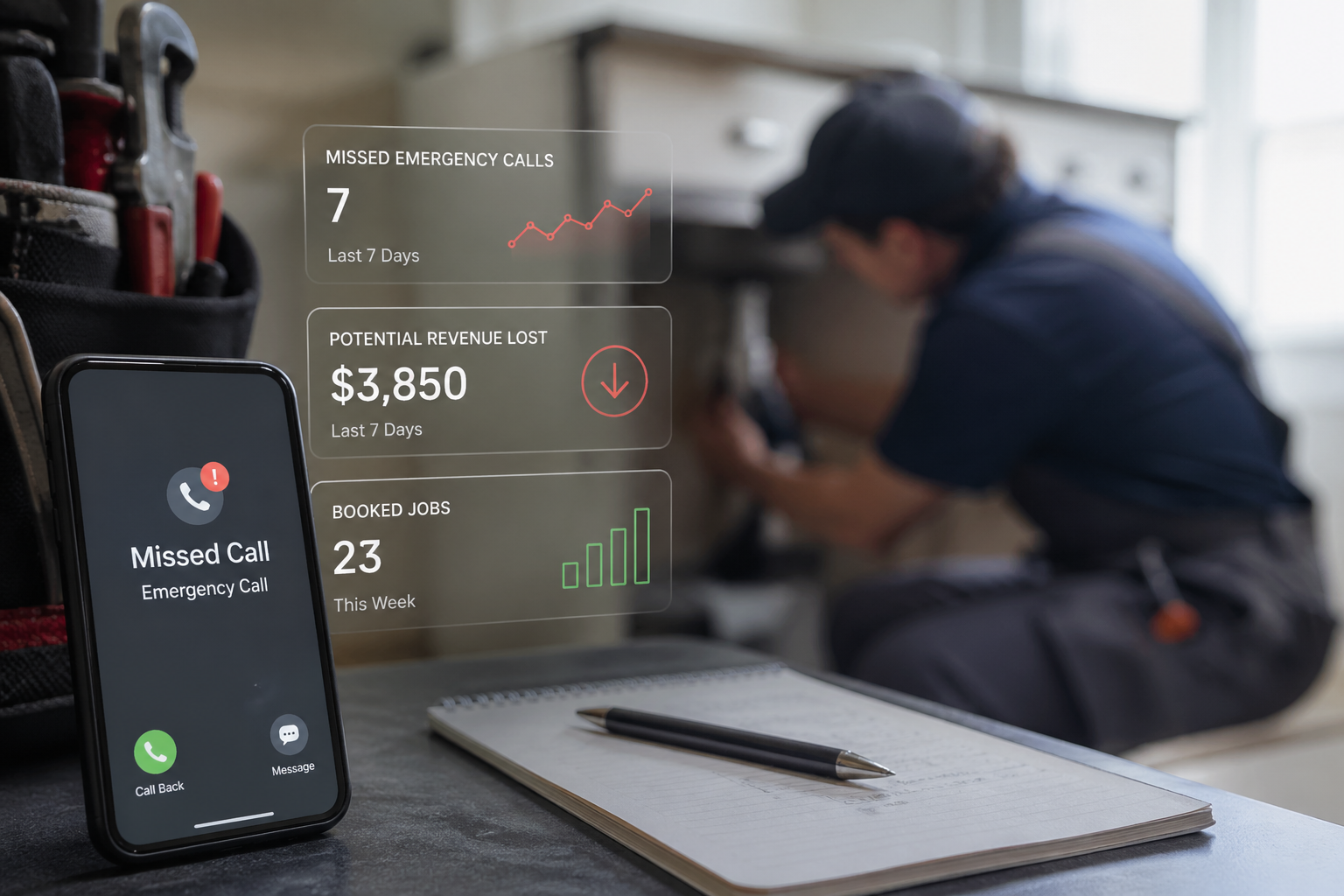
It's 2 AM on a sweltering July night, and Mrs. Henderson's AC just quit. She's desperate, uncomfortable, and willing to pay premium rates for immediate service. She finds your HVAC company online and calls—but nobody answers. By 2:07 AM, she's already booked with your competitor who has 24/7 phone coverage.
You just lost a $450 emergency service call, plus the potential $8,500 system replacement she'll need within six months, plus every referral she would have given you over the next decade. All because your phone went to voicemail at 2 AM.
Here's the brutal math: The average HVAC company misses 27% of inbound calls—and during your busiest seasons, that number spikes above 40%. According to home services industry data, each missed call represents an average $320 in lost immediate revenue, with emergency calls averaging $450-650. If your company receives just 30 calls daily and misses 27% of them, that's $876,000 in annual lost revenue walking straight to your competitors.
The problem isn't your team's dedication—it's the impossibility of answering every call while your technicians are on roofs, in crawl spaces, or driving between jobs. But what if you could capture every single call, qualify every lead, and dispatch emergency service requests instantly, all without hiring additional office staff?
The Emergency Call Crisis Crushing HVAC Profits
Let's get specific about what's happening to your bottom line right now.
Peak season call volume overwhelm: During summer heat waves and winter cold snaps, your phone volume doubles or triples overnight. Your office staff—already stretched thin managing dispatch, billing, and customer service—can't possibly keep up. Customers get busy signals, voicemails, or 10-minute hold times. Those who wait are frustrated; most simply hang up and call the next contractor on Google.
A major HVAC contractor in Phoenix tracked this during a July heat wave: incoming calls jumped from 45 daily to 127. They captured 58% of those calls. The other 42%—53 calls daily—went to competitors. At an average ticket of $380, they watched $20,140 disappear every day for two weeks. That's $282,000 in lost revenue from a single weather event.
After-hours revenue black hole: Industry research shows that 35-40% of HVAC emergency calls occur outside traditional business hours. Furnaces fail at midnight. AC units quit on Sunday mornings. These emergency calls carry premium pricing—often 1.5-2x standard rates—and desperate customers who aren't price shopping.
Yet most HVAC companies route after-hours calls to voicemail, a personal cell phone that may or may not be answered, or an answering service that takes messages without qualification or dispatch capability. The result? You're either paying technicians to be on-call while missing most opportunities, or you're leaving massive revenue on the table entirely.
The qualification bottleneck: Not every call deserves immediate dispatch. "What are your rates?" isn't the same urgency as "My basement is flooding from a burst pipe and the furnace is affected." But when your dispatcher is drowning in call volume, every call feels urgent, leading to poor prioritization and inefficient routing.
Manual call handling also means inconsistent information gathering. One dispatcher might capture complete details about the customer's system, problem symptoms, and location. Another, rushing through 15 backed-up calls, might only grab a name and address. Your technician arrives unprepared, extending job time and reducing profitability.
ServiceTitan integration gaps: Many HVAC companies have invested in ServiceTitan or similar field service management software, but their phone system doesn't integrate seamlessly. Dispatchers manually enter customer information, job details, and notes—wasting 3-5 minutes per call and creating data entry errors that lead to billing problems, scheduling conflicts, and frustrated customers.
Seasonal hiring nightmare: To handle peak season volume, you hire temporary staff. You spend 2-3 weeks training them on your systems, pricing, and customer service standards. By the time they're competent, the season is over. Next year, you start from scratch with new temps, repeating the expensive cycle.
How AI Answering Services Transform HVAC Operations
An AI answering service specifically designed for contractors functions as your always-available, infinitely scalable, expertly trained front office team member that never takes a break, never makes a scheduling mistake, and gets better with every call.
Intelligent emergency triage: When a call comes in, the AI immediately assesses urgency through natural conversation: "I understand your AC stopped working. Is anyone in the home experiencing heat-related discomfort? What's the current indoor temperature?" Based on the responses, it categorizes calls into emergency (immediate dispatch), urgent (same-day service), or standard (scheduled appointment) categories.
For genuine emergencies, the system can instantly notify your on-call technician via SMS and phone, providing complete job details, customer location, and system information. Your tech receives: "EMERGENCY - Mrs. Henderson, 2847 Oak Street, 85°F indoors, elderly resident, Carrier 3-ton unit stopped cooling, willing to pay emergency rates. Customer phone: 602-555-0123."
24/7/365 coverage with zero gaps: Unlike human answering services with shift changes, bathroom breaks, and lunch hours, AI systems handle calls continuously. The customer calling at 2 AM gets the same professional, knowledgeable service as someone calling at 2 PM.
The system recognizes returning customers by phone number: "Hi Mrs. Henderson, I see we serviced your Carrier unit last year. How can we help you today?" This personalization builds trust and loyalty while capturing important context.
ServiceTitan native integration: Modern AI answering services integrate directly with ServiceTitan, Housecall Pro, Jobber, and other field service management platforms. When a call ends, all customer information, job details, and scheduling decisions are automatically synced into your system. No manual data entry. No transcription errors. No dispatch delays.
The AI can check real-time technician availability in ServiceTitan and book appointments based on actual schedules, not outdated information. "I can schedule Jason to arrive between 2-4 PM today, or would you prefer an 8 AM slot tomorrow morning?" The customer sees immediate value; you see optimized routing and scheduling.
Lead qualification at scale: The AI asks strategic questions to qualify every lead: What type of system do they have? How old is it? What symptoms are they experiencing? Is this a rental or owned property? Are they the decision-maker? This information helps you prioritize high-value opportunities and prepare technicians appropriately.
For leads that aren't ready to book immediately, the AI captures complete contact information and can schedule follow-up calls, send email estimates, or route qualified leads to your sales team with detailed notes.
Dynamic pricing communication: Your AI system can explain pricing structures clearly and consistently: "Emergency service calls after 6 PM include a $125 trip charge plus hourly labor at $165/hour, with a 2-hour minimum. Parts are additional. Many repairs are completed within that 2-hour window." Customers appreciate transparency, and you eliminate the sticker shock that kills conversions.
Real HVAC Companies, Real Results
Phoenix HVAC contractor captures $340K in previously lost emergency calls: Desert Comfort Air Conditioning struggled with after-hours emergency calls. Owner Mike Rodriguez had technicians on-call rotation, but they'd miss calls while working on other emergencies or, honestly, while sleeping through their phones at 3 AM.
After implementing an AI answering service integrated with ServiceTitan, they captured 94% of after-hours calls compared to their previous 31%. "The first month, we ran 67 after-hours emergency calls versus 19 the previous July," Mike explained. "At an average ticket of $625 for emergency work, that's an additional $30,000 in a single month."
Over the first year, they captured an estimated $340,000 in emergency revenue that previously went to competitors. "The ROI is insane. We pay $699/month for the AI system. It's generating 48x that in monthly revenue."
Multi-location HVAC company slashes missed calls by 81%: ClimateControl Systems operates across four cities in Texas with 22 trucks. Managing call volume across locations was chaos—calls to the Dallas number often rang while the Houston office was slammed, and vice versa.
They implemented a centralized AI answering service that routed calls intelligently based on location and technician availability. Missed call percentage dropped from 34% to 6.5% company-wide within 30 days. "The system knows which location has available capacity and routes accordingly," explained Operations Director Sandra Liu. "We went from competing with ourselves for calls to functioning like a unified organization."
The business impact extended beyond captured revenue. Customer satisfaction scores increased from 7.8 to 9.1 out of 10, driven primarily by "responsive phone service" and "easy scheduling." Employee satisfaction also improved—dispatchers reported 70% less stress from phone overload.
Seasonal contractor eliminates hiring headaches: Mountain Peak Heating & Cooling in Colorado sees dramatic seasonal swings—winter heating emergencies and summer AC demand create peak periods where call volume triples. They'd historically hired 2-3 seasonal office staff, spending $8,000-12,000 on recruiting, training, and wages for employees who'd work 12-16 weeks.
The AI answering service eliminated this entirely. "We scaled from 35 calls daily in April to 115 calls daily in July without hiring anyone," said owner Beth Martinez. "The system handled it perfectly. Our permanent staff focused on dispatch optimization and customer retention instead of just answering phones."
The cost savings were significant—approximately $25,000 annually in eliminated seasonal hiring costs—but the consistency was even more valuable. "Every caller gets the same excellent service, whether it's our slowest Tuesday in March or our busiest Saturday in August."
Essential Features for HVAC AI Phone Systems
Not all AI answering services understand the specific needs of HVAC contractors. Here's what your system must include:
Emergency vs. non-emergency triage protocols: Your AI needs sophisticated decision trees that assess urgency based on multiple factors: system type (furnace in winter vs. AC in summer), vulnerable occupants (elderly, infants, medical equipment), temperature extremes, and customer urgency cues. A furnace failure on a 15°F night is different from a maintenance question about changing filters.
ServiceTitan/Housecall Pro/Jobber integration: Direct, real-time integration with your field service management software is non-negotiable. The AI should create job tickets, update customer records, check technician availability, and book appointments without human intervention. If your system requires manual data transfer, you're just shifting the bottleneck, not eliminating it.
Intelligent scheduling and dispatch: The AI should understand your service area geography, traffic patterns, technician specializations, and current schedules. When someone in North Phoenix calls for AC repair, the system doesn't book them with a technician wrapping up in South Phoenix if another tech is nearby.
Custom pricing communication: Every HVAC company has unique pricing structures—trip charges, emergency rates, diagnostic fees, maintenance contracts. Your AI must articulate your specific pricing clearly and handle common objections: "Yes, there is a trip charge, but that's credited toward your repair if you proceed with our recommended solution."
Parts availability checking: Integration with your inventory management system lets the AI answer: "Yes, we have that Carrier capacitor in stock and can complete your repair today" versus "We'll need to order that part, with arrival expected tomorrow."
Financing option explanation: Many HVAC repairs and replacements involve significant costs. Your AI should explain financing options clearly: "We offer 0% financing for 18 months on approved credit for system replacements, or we can schedule a free in-home estimate to discuss payment options."
Maintenance agreement handling: For existing maintenance contract customers, the AI should recognize their status, confirm their benefits ("As a Priority Service Member, you have no trip charges and receive priority scheduling"), and book appointments within their contract terms.
Weather-triggered response scaling: Smart systems monitor local weather and automatically adjust protocols. When a heat wave warning is issued, the AI can proactively communicate longer wait times, offer premium expedited service options, or suggest temporary cooling measures while waiting for service.
Multi-language support: HVAC emergencies don't only affect English speakers. Systems with Spanish, Mandarin, and other language support capture opportunities your competitors miss and serve your community more comprehensively.
Implementation: Getting Your HVAC Business AI-Ready
Setting up an AI answering service takes less time than you'd think—most HVAC contractors are fully operational within 5-7 business days.
Step 1: Document your current call handling process. Map out how calls currently flow: Who answers? What questions do they ask? How do they qualify emergencies? What information do they gather? How do they schedule? This documentation becomes your AI training foundation.
Step 2: Connect your field service management software. Your AI provider will need API access to ServiceTitan, Housecall Pro, or your system. Most platforms have straightforward integration processes, and your AI provider typically handles the technical setup. This usually takes 24-48 hours.
Step 3: Define your emergency criteria and protocols. Work with your AI provider to establish clear emergency triage rules: What situations require immediate dispatch? What temperature thresholds matter? How do you handle multiple simultaneous emergencies? These protocols ensure the AI makes decisions aligned with your business philosophy.
Step 4: Customize pricing and service explanations. Provide your pricing structure, service area boundaries, financing options, and common customer questions. The AI learns your specific language and approaches, sounding like a well-trained employee who's been with your company for years.
Step 5: Set up dispatch and notification protocols. Configure how the AI notifies your on-call technicians for emergencies, how it escalates if the first tech doesn't respond, and how it handles scheduling for non-emergency calls. You maintain complete control over operations.
Step 6: Train your team on the new system. Your dispatchers and techs need to understand how the AI works, what information they'll receive, and how to provide feedback for continuous improvement. Most companies find their teams love the system within days—it makes their jobs easier, not harder.
Step 7: Soft launch with call forwarding. Start by forwarding after-hours calls to the AI while keeping daytime calls with your existing team. This low-risk approach lets you validate performance before going all-in. Most companies expand to 24/7 AI handling within 2-3 weeks after seeing the results.
What to expect in the first 30 days: Week one typically shows immediate missed call reduction—you'll see it in your call logs. Week two, your team notices less phone stress and better focus on in-person customers. Week three, you'll see the first data on emergency call capture and revenue impact. By week four, the ROI becomes undeniable.
The Technician Impact: More Runs, Better Information
Your field technicians will notice significant changes—all positive.
Better pre-arrival information: Instead of showing up to "AC not working," techs receive: "Carrier 3-ton unit, 12 years old, stopped cooling 3 hours ago, homeowner reports warm air blowing, last service 14 months ago, no unusual sounds." This context lets them prepare appropriate parts and approach the diagnostic efficiently.
Reduced callback interruptions: When techs are elbows-deep in a challenging repair, the last thing they need is the office calling about their next appointment. The AI handles scheduling and customer questions, letting techs focus on the work in front of them.
More billable hours: The industry average shows HVAC technicians spend only 4-5 hours of their 8-hour shift on actual billable work. The rest is drive time, parts runs, and administrative overhead. Better call qualification and scheduling optimization increases billable time to 5.5-6.5 hours daily—a 20-30% revenue increase per technician without working longer.
Emergency call satisfaction: Techs on emergency rotation get qualified, genuine emergencies with customers who understand and accept premium pricing. No more showing up to "emergencies" that are actually maintenance questions, or customers shocked by after-hours rates because they weren't properly informed.
Pricing and ROI: The Numbers That Matter
Let's discuss real costs and real returns for HVAC companies.
AI answering service pricing: For contractors, expect $499-899/month depending on call volume and integration complexity:
- Standard tier ($499-599/month): Suitable for single-location HVAC companies with 100-300 monthly calls, includes ServiceTitan/Housecall Pro integration and emergency triage
- Professional tier ($699-799/month): For established companies with 300-600 monthly calls, includes advanced analytics and multi-location support
- Enterprise tier ($899-1,200/month): For large operations with 600+ calls or complex multi-location needs, includes white-glove support and custom integrations
The ROI calculation for HVAC contractors: Let's use conservative numbers for a mid-sized operation:
- AI answering service cost: $699/month
- Current monthly calls: 400
- Current missed call rate: 27% = 108 missed calls monthly
- AI capture rate: 94% = reduction to 24 missed calls = 84 additional captured calls
- Average ticket value: $340
- Conversion rate on answered calls: 45%
- Additional monthly revenue: 84 × 45% × $340 = $12,852
- Annual additional revenue: $154,224
- ROI: 1,741%
Even if these results are half as effective, you're still seeing an 870% return on investment.
Beyond direct revenue: Factor in these additional benefits:
- Eliminated seasonal hiring costs: $15,000-25,000 annually
- Reduced dispatcher overtime during peak seasons: $8,000-12,000 annually
- Improved technician utilization: 15-20% more billable hours
- Higher customer satisfaction leading to more referrals
- Competitive advantage in your market
Common Concerns and Real Answers
"Will customers know they're talking to AI?" Modern AI voice technology is remarkably natural. Most callers don't realize they're not speaking with a human for the first minute or more of conversation. More importantly, they care about results: "Was my emergency call handled appropriately? Did I get scheduled quickly?" The answer is consistently yes.
A survey of 600 HVAC customers who'd interacted with AI answering services showed 89% rated the experience as "good" or "excellent," with 72% saying they couldn't tell or didn't care whether it was AI or human.
"What about complex technical questions?" Smart AI systems recognize when questions exceed their training and seamlessly transfer to human experts. "That's a detailed technical question about your heat pump's refrigerant system. Let me connect you with one of our senior technicians who can provide specific guidance." The customer feels heard and helped, not frustrated by limitations.
"Will this replace my office staff?" No—it elevates them. Your dispatcher stops being a frazzled phone operator and becomes a strategic coordinator optimizing routes, managing customer relationships, and solving complex problems. Most HVAC companies maintain their existing staff while dramatically improving their capacity and customer experience.
"What happens during system outages?" Reputable AI answering service providers maintain 99.9%+ uptime through redundant systems, automatic failover protocols, and backup human answering services. Your phones never go unanswered, even in worst-case scenarios.
"How long before we see ROI?" Most HVAC contractors see positive ROI within 15-30 days:
- Day 1-7: Immediate reduction in missed calls, especially after-hours
- Day 8-14: First emergency call revenue data shows measurable increase
- Day 15-30: Staff reports reduced stress, better job satisfaction
- Day 30-60: Full ROI becomes clearly positive in financial reports
- Day 60-90: Customer satisfaction scores improve measurably
Taking Action: Capture Every Emergency Call Starting Today
You face a straightforward choice as an HVAC contractor:
Option 1: Continue with your current phone system. Accept that you'll miss 25-35% of calls, lose emergency revenue to faster-responding competitors, and watch peak season opportunities overwhelm your staff while leaving money on the table.
Option 2: Hire more office staff. Spend $40,000-60,000 annually per person, manage training and turnover, and still face limitations on after-hours coverage and peak season scalability.
Option 3: Implement an AI answering service designed for contractors. Capture 90%+ of all calls 24/7/365, integrate seamlessly with ServiceTitan, provide consistent excellent service, and see ROI within 30-60 days.
The HVAC industry is becoming increasingly competitive. Customers expect immediate response, especially for emergencies. The contractors winning market share in 2025 are those combining excellent technical work with exceptional accessibility and responsiveness.
Calculate your specific opportunity: Use our free HVAC Revenue Loss Calculator to see exactly how much money you're leaving on the table. Input your monthly call volume, current missed call percentage, and average ticket value to get personalized results showing your annual opportunity.
See it in action: Schedule a 15-minute demo where you'll see an AI answering service handle real HVAC scenarios—emergency triage, appointment scheduling, pricing questions, and ServiceTitan integration. You'll see exactly how it works with your existing systems.
Special offer for HVAC contractors: Start your 14-day free trial with complete ServiceTitan integration setup included. We'll configure emergency protocols, train the AI on your pricing and service area, and have you operational within 5 business days. If you don't see measurable improvement within 30 days, we'll refund your first month—guaranteed.
That 2 AM emergency call is ringing right now, somewhere in your service area. The only question is whether you'll answer it—or whether your competitor will.