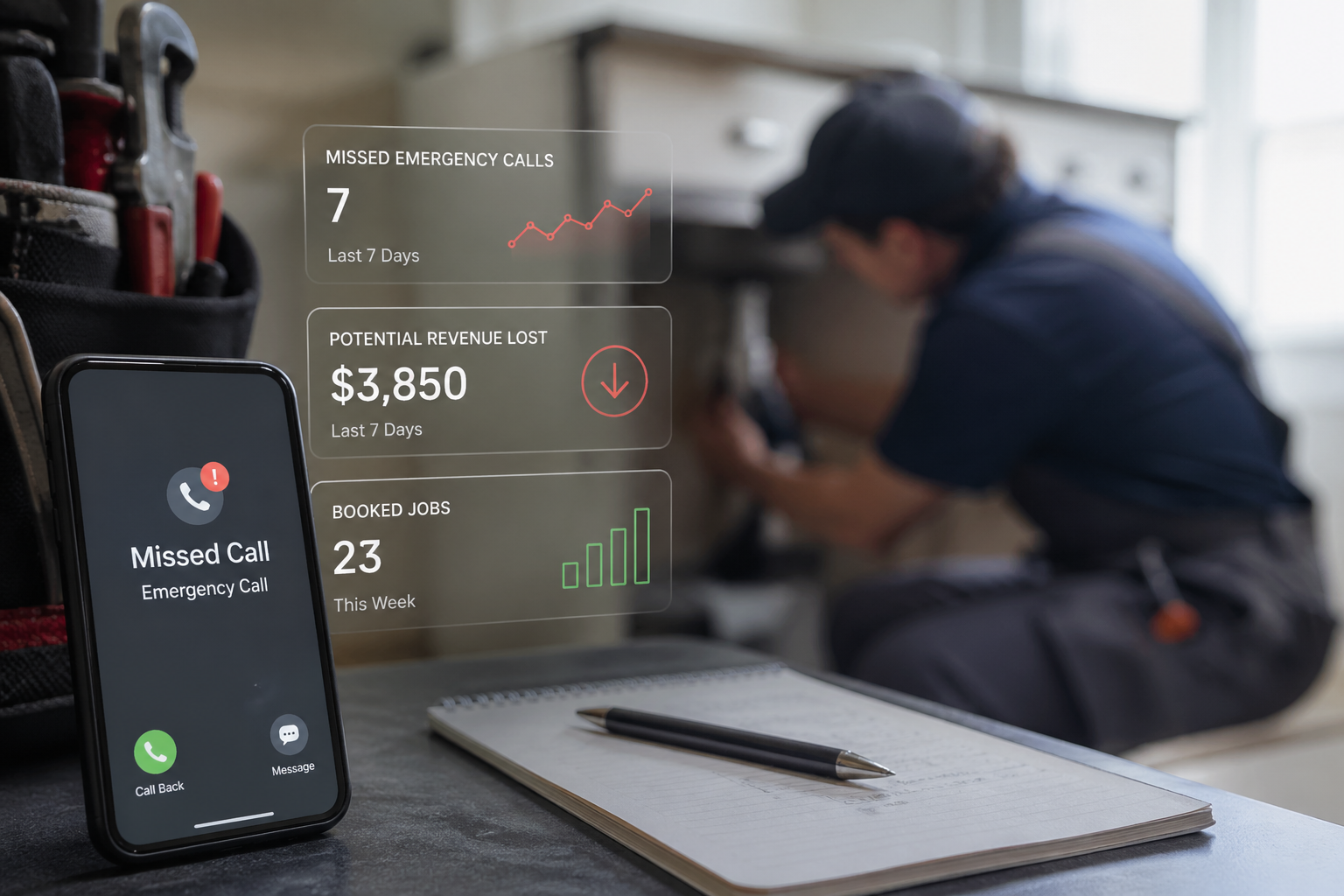
Are you losing potential clients because your team is too busy executing campaigns to answer the phone? The average marketing agency misses 34% of inbound calls during business hours, and that number jumps to 100% after 5 PM. When a business owner is ready to invest in marketing services, they're calling multiple agencies. If you don't answer, your competitor will.
For marketing agencies competing in an increasingly crowded market, every new business inquiry represents a potential six-figure client relationship. Yet most agencies treat phone answering as an afterthought, relegating it to junior staff members who are juggling multiple responsibilities or simply letting calls go to voicemail during client meetings and creative sessions.
The cost of this approach is staggering. If your agency receives 50 inbound leads per month with an average client value of $4,500 per month over 12 months, missing just 30% of those calls means leaving over $800,000 in annual revenue on the table. An AI phone system for marketing agencies solves this problem by ensuring every inquiry receives immediate, professional attention while your team stays focused on delivering exceptional results for current clients.
Why Traditional Phone Handling Fails Marketing Agencies
Marketing agencies face unique communication challenges that make traditional receptionist solutions inadequate. Your team members are constantly in client meetings, strategy sessions, creative reviews, and campaign execution mode. The last thing they need is constant phone interruptions disrupting their flow.
Here's what typically happens: A potential client calls during a pitch meeting. The call goes to voicemail. The prospect leaves a message asking about social media management services. By the time someone checks voicemail three hours later and returns the call, that business owner has already scheduled consultations with two other agencies. You've lost the opportunity before you even knew it existed.
Even when agencies hire dedicated receptionists, the challenge persists. A general receptionist lacks the marketing expertise to have meaningful conversations with prospects who ask detailed questions about SEO strategies, paid advertising ROI, or content marketing approaches. They can take messages, but they can't qualify leads or provide the immediate value that builds trust with potential clients.
Furthermore, marketing agencies often serve clients across multiple time zones and industries. A Los Angeles-based agency might receive inquiries from East Coast businesses at 6 AM Pacific time, or from restaurant clients calling after their evening service ends. Traditional 9-5 phone coverage means missing these valuable opportunities entirely.
How AI Phone Systems Transform Agency New Business Development
An AI phone system for marketing agencies acts as your 24/7 business development team member, handling initial inquiries with the professionalism and marketing knowledge that reflects your agency's expertise. Unlike generic answering services, modern AI receptionists can be programmed with industry-specific knowledge, qualifying questions, and intelligent routing that ensures the right team member gets involved at the right time.
When a prospect calls your agency, the AI receptionist greets them professionally, asks qualifying questions about their business needs, budget range, and timeline, then either books a consultation directly into your calendar or routes urgent inquiries to the appropriate team member based on expertise and availability. The system captures detailed information about the prospect's current marketing challenges, previous agency experiences, and specific services they're interested in exploring.
Agencies using AI phone automation report a 73% increase in qualified consultation bookings and a 45% reduction in time spent on initial lead screening. The system works around the clock, capturing after-hours inquiries from business owners who research agencies outside normal business hours, which represents 40% of all inbound leads for many agencies.
The technology integrates seamlessly with your existing CRM system, automatically creating lead records with detailed notes from the conversation, ensuring your sales team has complete context before the consultation call. This level of organization and responsiveness creates an immediate positive impression that sets you apart from competitors still relying on voicemail and manual follow-up processes.
Essential Features for Marketing Agency AI Phone Systems
Not all AI phone systems deliver equal value for marketing agencies. The right solution needs specific capabilities that address the unique requirements of agency new business development and client service.
Intelligent Lead Qualification
Your AI receptionist should ask strategic qualifying questions that help your team prioritize follow-up. This includes budget range ("Are you looking to invest $2,000-5,000 monthly, $5,000-10,000, or $10,000+ in marketing services?"), timeline urgency ("When are you hoping to launch these marketing initiatives?"), decision-making authority ("Will you be the primary decision-maker, or will others be involved?"), and current marketing situation ("What marketing efforts have you tried previously?").
The system scores leads based on these responses, ensuring your business development team focuses energy on the highest-potential opportunities first. A prospect with a $15,000 monthly budget, immediate need, and sole decision-making authority gets flagged as priority, while someone "just researching options" with no defined budget gets a different follow-up approach.
Automated Consultation Scheduling
The AI phone system should integrate with Google Calendar, Outlook, or scheduling tools like Calendly to book consultations directly during the initial call. The system checks your team's availability in real-time, offers multiple time slots that work for the prospect, confirms the appointment via email and SMS, and sends automated reminders 24 hours and 1 hour before the meeting to reduce no-shows by 40%.
This immediate scheduling capability is crucial because prospects are most engaged during that initial outreach moment. If you ask them to "check the calendar and call back," conversion rates drop dramatically. Capturing the commitment while they're on the phone transforms casual inquiries into confirmed opportunities.
Service-Specific Call Routing
Marketing agencies often have team members who specialize in different service areas. Your AI phone system should route calls intelligently based on the prospect's needs. A business asking about SEO gets routed to your search marketing specialist, paid advertising inquiries go to your PPC team, content marketing questions connect with your content director, and comprehensive strategy inquiries route to your agency principal or new business director.
This specialized routing ensures prospects speak with the team member best equipped to address their specific needs, creating confidence in your agency's expertise from the very first conversation. It also respects your team's time by eliminating unnecessary hand-offs and ensuring everyone focuses on their area of strength.
CRM Integration and Lead Tracking
Seamless integration with marketing agency CRM platforms like HubSpot, Salesforce, Pipedrive, or agency-specific tools like Function Point ensures every call becomes a documented lead record with complete conversation history. The system automatically logs call date and time, records the prospect's contact information, captures detailed notes about their needs and budget, assigns lead scores based on qualification criteria, and triggers appropriate follow-up workflows.
This integration eliminates the manual data entry that wastes hours each week and ensures no lead falls through the cracks because someone forgot to add them to the CRM after a busy day of client work.
Real Results: How Agencies Win More Business with AI Phone Systems
The impact of implementing an AI phone system extends beyond simply answering more calls. Agencies report fundamental transformations in their new business development efficiency and results.
Velocity Marketing Partners, a 12-person digital marketing agency in Denver, implemented an AI receptionist system after calculating they were missing 28 calls per week during client meetings and campaign execution time. Within 90 days, they saw a 64% increase in consultation bookings, 47% reduction in time from initial inquiry to scheduled meeting, and 52% improvement in show rates for consultations because of automated reminders.
The agency's founder noted that the AI system's lead qualification questions helped them avoid spending time on unqualified prospects. "We used to schedule consultations with anyone who called, then discover 30 minutes into the meeting that they had a $500 monthly budget for services we couldn't profitably deliver under $3,000. Now our AI receptionist qualifies budget upfront, and we only spend time with prospects who fit our ideal client profile. Our close rate went from 22% to 41% because we're talking to better-qualified leads."
Amplify Creative, a boutique agency specializing in e-commerce brands, found that 45% of their highest-value client acquisitions came from after-hours calls. "We serve nationwide e-commerce clients, and many of them are working on their business after their stores close for the day. Before implementing our AI phone system, we were completely missing this segment. Now we capture those evening inquiries, book morning consultations while the conversation is fresh, and we've added $340,000 in annual recurring revenue from clients who called outside business hours."
The numbers tell a compelling story across agencies of all sizes. Agencies using AI phone automation report an average 3.2x return on investment within the first six months, with larger ROI multiples for agencies that previously had no dedicated new business phone coverage.
Implementing AI Phone Systems Without Disrupting Current Operations
Marketing agency leaders often worry that implementing new technology will create disruption during busy seasons or require extensive setup time. Modern AI phone systems for marketing agencies are designed for rapid deployment with minimal technical complexity.
Phase 1: Setup and Configuration (Week 1)
Your implementation begins with a 30-minute consultation where you define your ideal qualification criteria, appointment types, and routing preferences. The AI system gets programmed with your agency's service offerings, pricing tiers, and common prospect questions. You integrate it with your existing calendar and CRM systems through simple OAuth connections that take minutes, not hours.
Most agencies are live and answering calls with their AI receptionist within 3-5 business days from the initial setup call. There's no hardware to install, no phone system to replace, and no technical expertise required from your team.
Phase 2: Testing and Optimization (Weeks 2-3)
During the first two weeks, the system handles calls while you monitor conversations and fine-tune responses. You might adjust qualification questions based on the types of inquiries you're receiving, modify appointment length or availability based on your team's capacity, refine routing rules as you see which specialists should handle which inquiries, or update CRM field mapping to capture additional lead information.
This optimization phase helps you customize the system to match your agency's specific sales process and terminology. The AI system learns from these adjustments, becoming more effective at representing your agency's unique value proposition with each refinement.
Phase 3: Full Integration (Week 4+)
By week four, your AI phone system operates as a seamless extension of your team. Your staff learns to trust the lead qualification, rely on the consultation bookings showing up in their calendars, and reference the detailed CRM notes before prospect calls. The system becomes invisible infrastructure that just works, freeing your team to focus on what they do best: creating and executing brilliant marketing strategies for clients.
Agencies report that the biggest surprise isn't the technology's sophistication but how quickly it becomes indispensable. "Within three weeks, I couldn't imagine running our agency without it," shared one agency owner. "It's like having hired a business development specialist who never sleeps, never forgets to follow up, and always asks the perfect qualifying questions."
Choosing the Right AI Phone System for Your Marketing Agency
Not every AI phone solution delivers the same value for marketing agencies. When evaluating options, prioritize systems built with professional services firms in mind rather than generic answering services adapted for business use.
Integration Ecosystem
Verify that the system integrates natively with the tools your agency already uses daily. For most marketing agencies, this means seamless connections with platforms like HubSpot for CRM and marketing automation, Google Workspace or Microsoft 365 for calendar and email, Slack for team communication and call notifications, project management tools like Asana or Monday.com, and proposal software like PandaDoc or Proposify.
Native integrations work better than Zapier connections because they sync in real-time and support bidirectional data flow. You want lead information flowing automatically into your CRM and calendar availability informing the AI receptionist's scheduling without any manual intervention or delays.
Customization and Control
Your AI phone system should be configurable to match your agency's unique processes and positioning. Look for solutions that allow you to customize greeting scripts and brand voice, define multiple appointment types with different durations, create custom qualification questions and scoring criteria, set up specialized routing rules for different services or team members, and adjust availability by time zone, day of week, or team member schedule.
Cookie-cutter solutions that offer limited customization force you to adapt your processes to the technology rather than the technology adapting to your proven sales approach. The best systems offer the flexibility to implement your methodology through the AI automation.
Analytics and Reporting
Understanding phone inquiry patterns helps you optimize marketing spend and staffing decisions. Your AI phone system should provide detailed analytics including call volume by time of day and day of week, lead source tracking when integrated with your website and advertising, conversion rates from inquiry to scheduled consultation, average qualification scores and characteristics of converted vs. lost leads, and common questions and concerns expressed by prospects.
These insights help you identify which marketing channels generate the highest-quality inbound leads, when you should make team members available for live consultation calls, and what objections or concerns to address proactively in your marketing messaging and sales conversations.
Integration with Your Marketing Agency Tech Stack
Modern marketing agencies operate within complex technology ecosystems, and your AI phone system needs to function as a connected component rather than a standalone tool requiring manual data transfer.
CRM Integration: Automated Lead Creation
When someone calls, your AI receptionist creates a complete lead record in your CRM including contact information, company details, service interests, budget range, timeline, pain points discussed, qualification score, and call recording transcript. This record automatically enters your lead nurturing workflow, triggering appropriate follow-up sequences based on the lead's characteristics and engagement level.
For agencies using HubSpot, the integration creates contacts with appropriate lifecycle stage, associates them with deals in your pipeline, and applies tags that trigger marketing automation workflows. Salesforce users get leads automatically assigned to the appropriate account executive based on territory, service line, or lead score. The system eliminates the data entry that previously consumed 4-6 hours weekly for agency teams.
Calendar Integration: Frictionless Scheduling
Your AI phone system checks calendar availability across multiple team members in real-time, presenting prospects with options that work for their schedule while respecting your team's existing commitments, meeting buffer times, and working hours. Once a consultation books, both parties receive confirmation emails with calendar invites, joining instructions for video calls, and preparation materials you've configured.
The system sends automated reminders via email and SMS at intervals you define, typically 24 hours and 1 hour before the meeting. These reminders reduce no-shows by 40% while requiring zero effort from your team. If a prospect needs to reschedule, they can do so through a link in the reminder message, and the system automatically finds a new time and updates everyone's calendars.
Collaboration Tools: Team Awareness
When high-priority leads call, your AI phone system can send instant notifications to your Slack channel or Microsoft Teams space, alerting business development team members that a qualified opportunity needs follow-up. For extremely urgent inquiries or calls requesting specific team members, the system can route to mobile phones, ensuring your agency remains responsive even when people are working remotely or traveling.
This real-time awareness means your team stays connected to new business activity without constantly checking the CRM or email. Important opportunities get immediate attention while your workflow remains uninterrupted for routine inquiries that the AI system handles completely.
Cost Analysis: AI Receptionist vs. Traditional Solutions
Understanding the financial implications helps agency leaders make informed decisions about phone automation investments. Let's examine the real costs across different approaches.
Traditional Human Receptionist: $45,000-65,000 Annually
Hiring a full-time receptionist includes base salary of $35,000-45,000, benefits and taxes adding 25-30% to base salary, training time and ongoing management, limited coverage (40 hours per week maximum), sick days, vacation time, and turnover costs when they leave. You're investing $4,000-5,500 monthly for coverage that still misses 60% of weekly hours and weekends entirely.
Outsourced Answering Service: $800-2,500 Monthly
Traditional answering services charge per call or per minute, typically $0.80-1.50 per call or $0.75-2.00 per minute. An agency receiving 200 calls monthly at 3 minutes average pays $1,200-3,600 monthly. These services provide basic message-taking but lack the qualification capabilities, CRM integration, and scheduling automation that convert inquiries into booked consultations. Your team still does all the follow-up work manually.
AI Phone System for Agencies: $299-699 Monthly
AI receptionist services like Dialiq deliver 24/7 coverage with intelligent qualification, automated scheduling, CRM integration, and unlimited calls with no per-minute charges. Most marketing agencies pay $299-499 monthly, making the ROI calculation straightforward: if the system books even two additional consultations monthly that convert to clients, it pays for itself many times over.
One consultation that converts to a $4,500 monthly retainer client produces $54,000 in annual revenue. Your AI phone system needs to generate just one additional client annually to deliver a 100x return on the investment. Most agencies report capturing 3-8 additional clients per year directly attributed to improved phone coverage and response time.
Getting Started with Your AI Phone System
Implementing an AI phone system for your marketing agency doesn't require technical expertise or significant time investment. The process is designed for quick deployment with immediate impact on your new business development results.
Step 1: Assess Your Current Phone Inquiry Handling
Begin by understanding your baseline metrics. Review your call logs for the past 30 days to determine how many inbound calls you receive weekly, what percentage get answered by a person versus voicemail, how quickly your team returns missed calls, and how many inquiries convert to scheduled consultations. This baseline helps you measure improvement after implementing AI phone automation.
Most agencies discover they're missing far more opportunities than they realized. One agency founder told us, "I thought we were pretty good about returning calls promptly. Then I actually analyzed our phone logs and discovered we were missing 42 calls per week and averaging 4.5 hours before returning voicemails. It was sobering."
Step 2: Define Your Qualification Criteria
Document what constitutes a qualified lead for your agency. This typically includes minimum monthly budget thresholds, service alignment with your agency's expertise, geographic considerations if you focus on local clients, company size or industry if you specialize, timeline urgency, and decision-making authority. These criteria inform how your AI receptionist qualifies and scores leads during initial conversations.
Be specific about disqualifiers too. If your agency doesn't serve businesses with less than $10 million in annual revenue, or doesn't take on clients seeking only one-time projects rather than ongoing relationships, your AI system should identify these mismatches early and direct inquiries appropriately rather than wasting consultation time.
Step 3: Map Your Ideal Sales Process
Document your current sales journey from initial inquiry to signed agreement. Identify where phone inquiries enter this process, what information you need to collect during the initial conversation, who should be involved at different stages, what appointment types you need (discovery calls, strategy sessions, proposal presentations), and how leads should be nurtured between touchpoints.
Your AI phone system implements this documented process automatically, ensuring consistency and completeness across every inquiry regardless of when it occurs or which team member ultimately takes the consultation.
Step 4: Implement and Test
Once your system is configured, implement with a soft launch where you monitor all calls and fine-tune responses based on real conversations. This testing period typically lasts 1-2 weeks before you fully trust the system to operate independently. During testing, review call transcripts, adjust qualification questions or routing rules as needed, refine appointment types or durations, and train team members on the new workflow.
Most agencies go fully live within 2-3 weeks from initial setup, capturing immediate value from improved response time and lead qualification while continuing to optimize the system based on results and feedback.
Transform Your Agency's New Business Development Today
Marketing agencies excel at generating leads and building brands for clients, but many neglect applying those same principles to their own business development. An AI phone system for marketing agencies ensures you never miss an opportunity to showcase your expertise and capture high-value client relationships.
The competitive advantage goes beyond simply answering more calls. It's about creating an exceptional first impression that reflects your agency's sophistication and attention to detail. When prospects experience immediate response, intelligent conversation, and frictionless scheduling, they conclude that your agency brings the same operational excellence to client work. You're selling your services through your actions, not just your words.
The agencies winning in today's competitive market are those that combine creative excellence with operational efficiency. AI phone automation represents the operational infrastructure that lets your talented team focus on the creative and strategic work they love while ensuring no opportunity slips through the cracks because someone was in a client meeting when a prospect called.
Your next six-figure client might call tomorrow at 7 PM when your office is dark and silent. Will they reach voicemail and call your competitor, or will they experience immediate professional attention that begins a relationship leading to long-term partnership? The difference is an AI phone system that works as hard as your agency team does.