Why Your Business Needs More Than Generic AI

Custom AI solutions are the strategic answer for businesses seeking intelligent automation custom to their unique workflows, proprietary data, and competitive positioning. While off-the-shelf AI tools offer quick, cost-effective deployment for general tasks, custom AI delivers:
- Precision for your specific industry - Built around your niche requirements (legal standards, medical compliance, real-time logistics)
- Proprietary data advantage - Train models on your unique datasets that competitors can't access
- Scalable architecture - Grows with your business demands without rigid limitations
- Measurable ROI - Drive operational cost reductions of 40%+ and open up new revenue streams
- Competitive differentiation - Create capabilities rivals simply can't replicate
If you're a service business drowning in missed calls, scheduling chaos, or inconsistent customer experiences, you already understand the pain of generic solutions that don't quite fit. A medical practice needs AI that understands HIPAA compliance and patient urgency. A veterinary clinic requires systems that handle anxious pet owners at 3 AM. A hotel demands multilingual support that captures every booking opportunity.
The market opportunity is massive and growing. Businesses that deploy custom AI report up to $12M+ in annual savings by optimizing infrastructure and workflows. Code-customized models deliver 83.9% better accuracy on specialized benchmarks compared to generic alternatives. Companies working with external AI integration partners see accelerated time-to-value, turning months of development into weeks of strategic deployment.
But here's the reality: most businesses don't have in-house AI talent. Over 50% lack the skilled expertise to build and manage custom models at scale. This is where the right approach—and the right partner—makes all the difference.
I'm Shaunak, founder of DialIQ, where we've built AI receptionists that handle millions of customer interactions across 40+ industries, solving the exact problem of missed opportunities and overwhelmed staff. Through deploying Custom AI solutions for service businesses, I've learned what truly works when moving from generic tools to purpose-built intelligence.
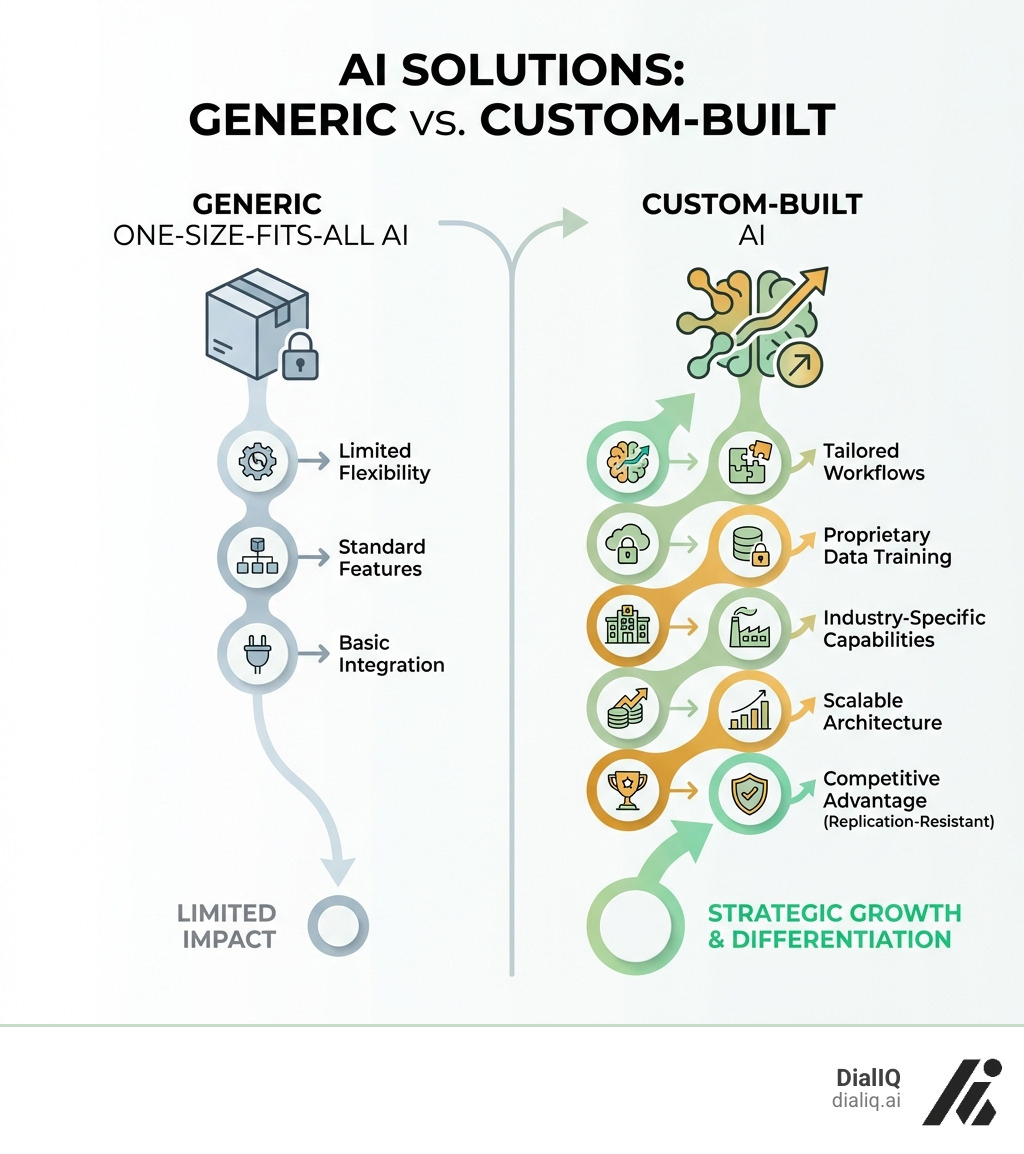
Pre-Built vs. Custom AI: Making the Right Choice
Choosing the right AI solution for your business can feel like standing at a crossroads. On one path, there's the convenience and familiarity of off-the-shelf options. On the other, the promise of bespoke, perfectly custom Custom AI solutions. Which way should we go? The decision hinges on understanding our unique needs, our data, and our long-term strategic goals.

The core difference between pre-built and Custom AI solutions lies in their flexibility, specificity, and the value they can open up. Pre-built AI is like a ready-made suit: it might fit well enough for many occasions, but it’s unlikely to be perfect. Custom AI solutions, on the other hand, are tailor-made. They're designed from the ground up to address our specific challenges, integrate with our unique systems, and leverage our proprietary data in ways generic tools simply can't.
Here's a quick comparison to help us visualize the distinction:
| Feature | Pre-Built AI Solutions | Custom AI Solutions |
|---|---|---|
| Flexibility | Limited, general-purpose | High, custom to specific needs |
| Cost | Lower initial investment, subscription-based | Higher initial investment, significant long-term ROI |
| Implementation | Fast, immediate availability | Slower, requires development and integration |
| Scalability | Can be challenging to scale for unique demands | Built with scalability in mind, adapts to growth |
| Competitive Edge | Minimal, accessible to all competitors | Significant, unique capabilities that are hard to replicate |
| Data Usage | Uses common data patterns, limited proprietary data use | Leverages proprietary data for unique insights and accuracy |
When Pre-Built AI Is Enough
For many businesses, especially those just beginning their AI journey or tackling common problems, pre-built AI solutions are an excellent starting point. They offer ease of use, immediate availability, and affordability. If our needs are general, such as basic sentiment analysis for customer feedback or simple chatbot functionalities for common FAQs, an off-the-shelf tool might be perfectly adequate. For instance, a pre-built tool like AWS Comprehend allows businesses to quickly set up sentiment analysis. These solutions are fantastic for streamlining standard business processes without requiring significant upfront investment or specialized technical expertise. They're the perfect fit when speed and cost-effectiveness outweigh the need for deep customization.
When to Invest in Custom AI
However, as our business evolves, or if our operations involve highly specialized tasks, unique industry requirements, or complex data needs, pre-built solutions quickly show their limitations. This is when we should seriously consider investing in Custom AI solutions.
Imagine we operate in a highly specialized field where industry-specific terminology or multilingual text processing is essential. Pre-built tools might fall short, lacking the nuanced understanding required. Or perhaps our business relies on large, diverse datasets that need to be processed in real-time or require advanced analysis. Companies dealing with dynamic supply chain logistics, real-time financial trading, or complex IoT sensor data will find that generic tools simply can't keep up.
This is where custom solutions shine. They allow us to build models custom to our specific data, giving us granular control over performance and outcomes. Platforms like AWS SageMaker and Google Vertex AI provide robust environments for building and training these bespoke models. Even tools like Azure’s AI Search can be extended and customized with additional training, giving us a flexible way to create AI custom to specific needs. When we need deep insights, advanced capabilities, and the ability to scale with our unique business growth, custom AI becomes not just an option, but a strategic imperative. It's about ensuring our AI truly works for us, not just alongside us.
The Strategic Advantages of Custom AI
Investing in Custom AI solutions isn't just about adopting new technology; it's about fundamentally changing our business for sustained growth and market leadership. The benefits extend far beyond mere automation, touching every aspect of our operations and strategic positioning.

At its core, custom AI offers measurable business results, deeper insights, and the best possible accuracy for our specific challenges. It drives operational efficiency by automating complex, data-heavy workflows, leading to significant efficiency gains and often, a healthier bottom line. We can achieve truly personalized customer experiences, make data-driven decisions with confidence, and gain a level of control that off-the-shelf products can't match. For example, our own AI-powered receptionists are designed to provide specialized care for veterinary clinics, hotels, and other service businesses, ensuring every call is answered with industry-specific understanding. You can learn more about how these capabilities are integrated into our systems on our features page.
Gaining a Competitive Edge
In today's fierce market, a competitive advantage isn't a luxury; it's a necessity. Custom AI solutions provide exactly that, by allowing us to mobilize our proprietary data and translate our unique domain expertise into intelligent systems that competitors simply cannot replicate.
Imagine having a system trained on years of our company's unique customer interactions, sales data, or operational logs. This proprietary data, combined with a custom-built AI model, generates insights and automates processes that are exclusive to us. It's like having a secret weapon that continuously learns and improves, creating a powerful "business moat." Our customized models, for instance, have shown remarkable results: our custom Korean model achieved 18% better accuracy on key Korean benchmarks than an open-source competitor with nearly 7 times more parameters. Similarly, our custom Japanese 7B model delivers state-of-the-art Japanese language performance, and our customized Command R7B Arabic model outperforms all key competitors on Arabic benchmarks. These examples highlight how code-customized models can deliver an 83.9% improvement in accuracy on specialized benchmarks, directly translating to superior performance and unique market insights.
Achieving Significant ROI and Scalability
The initial investment in Custom AI solutions can seem substantial, but the long-term return on investment (ROI) and scalability benefits are often profound. Businesses consistently report a significant reduction in operational overhead through the automation of complex, data-heavy workflows. This translates into substantial efficiency gains and annual cost savings. For a globally recognized customer, implementing custom AI led to annual savings of over $12 million by optimizing infrastructure and refining predictive resource allocation.
Beyond cost savings, custom AI is built with scalability in mind. As businesses grow, so do their data and operational complexity. A custom solution can adapt to new data, expand with our operations, or shift with our business strategies. Unlike rigid, off-the-shelf tools, custom AI offers the flexibility to evolve, ensuring that our investment continues to deliver value for years to come. This adaptability is crucial for long-term growth and maintaining relevance in a rapidly changing market. For a deeper dive into the cost comparison and ROI for specific applications like AI receptionists, we can explore resources like AI Receptionist vs. Human Receptionist: The Real Cost Comparison for SMBs. Platforms and frameworks like TensorFlow are often chosen for custom AI development precisely because they offer the scalability needed to handle growing data volumes and computational demands.
Your Roadmap to Building Custom AI Solutions
Starting on the journey of building Custom AI solutions might seem daunting, but with a clear roadmap, it becomes a strategic and manageable endeavor. It's an iterative process that moves from defining our problem to deploying and continuously refining our intelligent systems.
This roadmap encompasses a thoughtful data strategy, a meticulous model development lifecycle, and robust MLOps practices for deployment and ongoing maintenance. Think of it as a continuous improvement cycle, where each step informs and refines the next.
Step 1: Define Purpose and Identify Use Cases
Before we write a single line of code or gather any data, the most crucial first step is to clearly define the purpose of our AI solution. What specific business problem are we trying to solve? What task will our AI perform? And what outcomes or metrics will determine its success? Without a well-defined problem statement, even the most advanced AI can become a solution looking for a problem.
We need to identify high-value opportunities where AI can make a real difference. For example, a common pain point for service businesses is managing phone calls and appointments. A clear use case could be automating call handling and scheduling. An AI Receptionist for Small Business is a prime example of a custom AI solution designed to solve the very tangible problem of missed calls and booking errors, directly impacting customer satisfaction and revenue. By setting clear, measurable success metrics (Key Performance Indicators or KPIs) from the outset, we ensure our AI project is aligned with our organizational goals and delivers tangible value.
Step 2: Data Collection, Preparation, and Governance
Data is the lifeblood of any effective AI model. Without high-quality, relevant data, our custom AI solutions are simply sophisticated guesswork. This step is about understanding what data we have, what data we need, and how to make it pristine for our AI.
We start by assessing our existing datasets and identifying any gaps. Data collection methods can include leveraging existing internal databases, web scraping for publicly available information, or even crowdsourcing. The goal is to gather a large, relevant, and high-quality dataset that accurately reflects the patterns our AI needs to learn.
Once collected, data preparation is paramount. This involves cleaning (removing duplicates, handling missing values, correcting inconsistencies), normalization (scaling numerical data so it plays nicely together), and splitting our data into training, validation, and testing sets. This meticulous preparation ensures our model learns from accurate information and can generalize well to new, unseen data. We can't stress this enough: "garbage in, garbage out" is especially true for AI.
Finally, we accept a "governance-first philosophy." This means establishing clear policies for data privacy, security, and ethical use from day one. Addressing ethical implications and potential biases proactively is vital for responsible AI development and to prevent unintended negative consequences. Data governance ensures our data is not only high-quality but also used responsibly and compliantly throughout the AI lifecycle.
Step 3: Model Development, Training, and Optimization
With a clear purpose and sparkling clean data, we move into the exciting phase of model development. This is where we design the brain of our Custom AI solutions.
First, we choose the right AI technology and platforms. This decision depends on the complexity of our problem and the type of data we're working with. Cloud platforms like Google Vertex AI offer powerful tools and infrastructure for building, deploying, and scaling machine learning models.
Next, we design the model architecture. This involves selecting the appropriate algorithms and structures (e.g., neural networks, decision trees) that are best suited to learn from our data and perform our specific task. The architecture often consists of an input layer, hidden layers where the model processes data, and an output layer that generates the final prediction.
Then, we train the model. This is an iterative process where the model learns from our prepared data, adjusting its internal parameters to minimize prediction errors. Key training considerations include setting hyperparameters (settings that control the learning process), defining a loss function (which measures how far off our predictions are), and selecting an appropriate training algorithm.
Finally, we enter the optimization loop – a continuous cycle of evaluation and refinement. This involves systematically measuring performance with tools like Evals, which establish a baseline for accuracy and provide feedback. We then iterate on prompts (if we're working with large language models) to guide the AI's output, giving context, instructions, and goals. And for more specific tasks, we might fine-tune the model, training it further on our specialized data to excel at a particular function. This iterative approach ensures our AI models are continuously improving, becoming more accurate, and better aligned with our business needs.
Navigating Challenges and Ensuring Success
Even with a clear roadmap, building and deploying Custom AI solutions comes with its share of challenges. But like any complex journey, anticipating these problems allows us to prepare and steer them effectively, ensuring our AI initiative is a resounding success.
Common challenges often include a lack of skilled technical talent, managing the budget and resources required for development, and seamlessly integrating the new AI solution with our existing business systems. Evaluating the performance and effectiveness of our custom AI models over time also requires dedicated effort and specialized tools. But with the right strategies and a proactive approach, these challenges become stepping stones to greater innovation.
Ensuring Security, Privacy, and Ethics
In the age of AI, trust is paramount. Ensuring the security, privacy, and ethical considerations of our Custom AI solutions is not just good practice; it's a fundamental responsibility. We must prioritize these aspects from the very beginning of the development process.
This means adhering strictly to data privacy regulations like GDPR or HIPAA, depending on our industry. We need robust security measures to protect the sensitive data our AI models process and learn from. Beyond security, ethical considerations are critical. We must actively work on bias detection and mitigation to ensure our AI systems are fair and equitable, avoiding unintended discrimination or harm. Model interpretability—understanding how and why an AI makes a particular decision—is also crucial for accountability and building trust. Our goal is to build trustworthy AI that integrates human oversight, ensuring that our intelligent systems serve humanity responsibly.
Integrating and Maintaining Your Custom AI Solution
A brilliantly designed AI model is only as good as its integration into our existing business systems and workflows. The goal is seamless adoption, not disruption. This means planning for how our custom AI will communicate with our current software, databases, and operational processes.
This is where MLOps (Machine Learning Operations) comes into play. MLOps provides a set of practices for deploying and maintaining machine learning models in production reliably and efficiently. It's about continuous monitoring, ensuring our AI models perform as expected and don't suffer from "model drift"—a phenomenon where model accuracy degrades over time due to changes in the underlying data patterns. Through MLOps, we can continuously evaluate the performance and effectiveness of our custom AI solutions, updating them with new data and refining them to maintain optimal performance. For instance, ensuring our AI Phone System for SMBs integrates perfectly with our CRM system or scheduling software is a prime example of successful integration and maintenance, making our operations smoother and more efficient.
Frequently Asked Questions about Custom AI
What are the core differences between pre-built and custom AI solutions?
The fundamental difference lies in their specificity and flexibility. Pre-built AI solutions are like mass-produced tools: they offer a general, one-size-fits-all approach designed to solve common problems across various businesses. They are quick to deploy, often come with a lower initial cost, and require less technical expertise to get started. However, their flexibility is limited; they may not perfectly fit our unique operational nuances or leverage our proprietary data.
Custom AI solutions, conversely, are tailor-made. They are developed from the ground up to address our specific business needs, workflows, and data landscape. This bespoke approach offers superior performance, deeper insights, and a significant competitive edge because the AI is optimized for our exact context. While they typically involve a larger initial investment in time and resources for development, the long-term benefits in accuracy, efficiency, and strategic advantage are far greater.
What is the typical cost associated with developing custom AI?
The investment required for developing Custom AI solutions varies widely, making it challenging to pinpoint a "typical" cost. It can range from tens of thousands to several millions of dollars, depending on factors like the complexity of the problem, the volume and type of data required, the sophistication of the models, the integration needs, and the size and expertise of the development team.
However, focusing solely on the cost misses the bigger picture: the potential return on investment (ROI). Custom AI solutions are strategic investments designed to yield significant benefits. These benefits can include substantial operational cost savings through automation (some businesses report an average reduction in operational overhead of 40%), increased revenue from personalized customer experiences, and improved efficiency across the board. For example, some globally recognized customers have achieved annual savings exceeding $12 million by optimizing infrastructure and refining predictive resource allocation through custom AI, as highlighted by our partners at Pythian. When considering custom AI, we should evaluate it through the lens of its transformative power and long-term value.
How can a business without in-house AI talent get started?
It's a common challenge: many businesses recognize the power of AI but lack the specialized in-house talent to develop and manage it. In fact, over 50% of businesses struggle with a lack of skilled talent and in-house expertise, making it difficult to properly integrate and manage AI models at scale.
The good news is that we don't have to go it alone. Many businesses successfully get started by partnering with external AI development firms or consultants. These partners bring the necessary expertise across the entire AI lifecycle, from initial strategy and identifying high-value use cases to data preparation, model development, deployment, and ongoing maintenance. Working with external integration partners can accelerate time-to-value, helping us bridge the internal talent gap and leverage cutting-edge AI without the overhead of building a dedicated in-house team from scratch. It's about finding the right experts to guide us through the process and build the custom AI that works specifically for us.
Conclusion: Your Future is Custom-Built
The journey from generic tools to a bespoke AI system is a strategic imperative for businesses aiming to lead their industry. By creating AI that is uniquely yours, you open up unparalleled efficiency, deeper insights, and a lasting competitive advantage. For service-based businesses like veterinary clinics and hotels, a purpose-built Conversational AI Receptionist from a specialized provider like DialIQ can be the first step in this change. Ready to build an AI that works just for you?
Learn how a tailored AI receptionist can transform your veterinary practice