Why Modern Dental Practices Are Turning to Automation
Dental practice automation is the use of technology to streamline repetitive tasks like appointment scheduling, patient communication, billing, insurance verification, and compliance tracking—freeing your team to focus on patient care while reducing costs and errors.
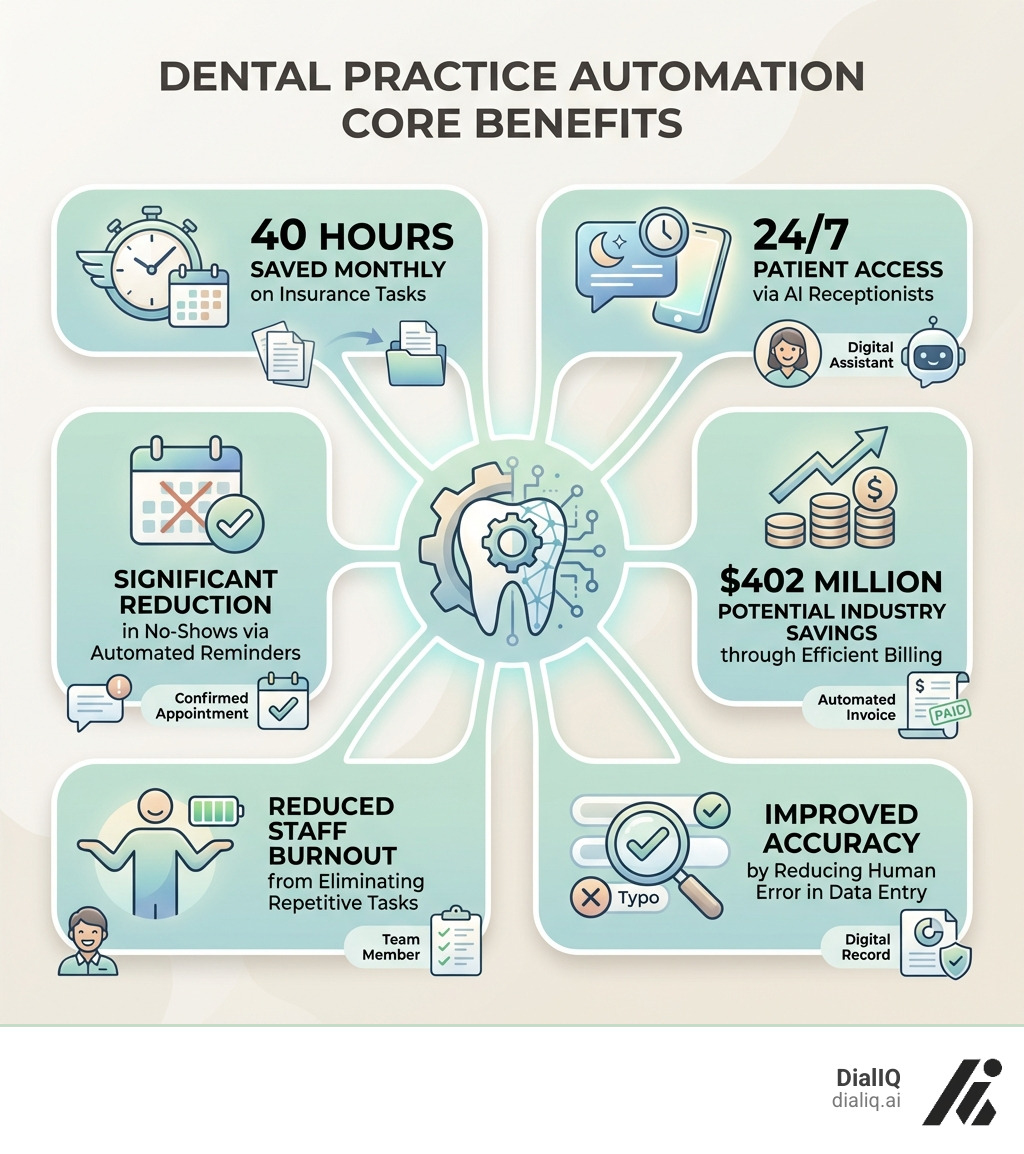
Key benefits of dental practice automation include:
- Time Savings: Practices lose up to 40 hours monthly on manual insurance tasks alone
- Cost Reduction: Industry-wide savings potential of $402 million through efficient billing processes
- 24/7 Availability: AI receptionists and automated systems work around the clock
- Reduced No-Shows: Automated reminders significantly decrease missed appointments
- Staff Relief: Teams spend less time on repetitive work and more on patient care
- Improved Accuracy: Automation eliminates human error in data entry and billing
Running a dental practice means juggling patient care, staff management, insurance claims, compliance requirements, and countless phone calls. The administrative burden is real—and it's costing you time, money, and peace of mind.
The front desk is often the busiest spot in your practice. Phones ring nonstop, appointment requests pile up, and your team struggles to keep up while also greeting patients in person. Meanwhile, billing errors slip through, follow-ups fall through the cracks, and your staff feels the strain of doing everything manually.
The good news? Technology has caught up with your challenges. Automation isn't just for large corporations anymore—it's accessible, affordable, and purpose-built for dental practices like yours.
I'm Shaunak, and I'm building DialIQ—an AI receptionist that answers every business call 24/7 for dental practices and other service businesses. Through helping practices implement dental practice automation, I've seen how the right tools can transform overwhelmed teams into efficient operations that never miss a patient inquiry.
Opening up Efficiency: The Primary Benefits of Automation
When we talk about dental practice automation, we're not just discussing minor tweaks; we're envisioning a complete overhaul of how your practice operates. The primary benefits extend across every facet of your business, creating a ripple effect of positive change.
First and foremost, automation leads to significant time savings. By offloading repetitive, mundane tasks, our teams can reclaim precious hours previously spent on administrative chores. This directly translates into cost reduction, as we optimize staff utilization and minimize overtime. But it's not just about the bottom line; automation dramatically improves the patient experience by offering convenience, faster service, and more personalized interactions.
Increased profitability is a natural outcome of improved efficiency and improved patient satisfaction. Happy patients are loyal patients, and a streamlined operation means we can serve more of them with higher quality care. Furthermore, automation contributes to staff satisfaction by reducing burnout and allowing our team members to focus on meaningful patient interactions rather than being stuck in a "droning cycle" of paperwork.
Perhaps one of the most critical advantages is the reduction of human error. Manual processes are inherently prone to mistakes, whether it's a misplaced decimal in billing or a forgotten reminder. Automation, especially when powered by AI, ensures consistency and accuracy, leading to fewer rejections, better compliance, and a more reliable operation. These aren't just short-term gains; they are long-term advantages that position our practices for sustainable growth and a sterling reputation.
We've seen how automated reminders significantly reduce missed appointments, a common drain on practice revenue and chair time, as reported by industry publications. For a deeper dive into the financial wisdom, you can explore more on the real cost comparison for dental practices between traditional and AI-powered solutions.
How Automation Saves Time and Money
Let's get down to brass tacks: time is money, and manual tasks are often money pits. Consider this: dental practices seeing 750 patients per month may be losing up to 40 hours in that month to manual and partially manual tasks related to reconciling insurance payments. That's a staggering amount of time that could be better spent. This translates to around $1,125 per month or more in lost productivity for a 750-patient practice.
By automating these processes, we can drastically cut down on these wasted hours, directly impacting our labor costs. Automating repetitive tasks means reducing the need for additional staff members and limiting the amount of time your team works overtime, leading to substantial savings. Cumulatively, dental providers across the industry could realize up to $402 million in savings by adopting more efficient insurance billing processes that include eliminating hard-copy explanation of benefits in favor of electronic remittance advice.
Beyond insurance, think about the administrative costs associated with paper forms, printing, filing, and manual data entry. Automation streamlines these, leading to a leaner, more efficient operation. It's about working smarter, not harder, and letting technology handle the heavy lifting so our human teams can shine. If you're curious about the potential investment, you can learn about AI call handling pricing to understand the cost-effectiveness.
Improving the Patient Journey
The patient experience is paramount, and dental practice automation is a powerful tool for enhancing it at every touchpoint. Imagine a patient wanting to book an appointment at 10 PM. With 24/7 accessibility through automated online booking and AI assistants, they can do so instantly, without waiting until morning. This convenience is a game-changer, reducing patient wait times and frustration.
Personalized communication, delivered consistently through automation, makes patients feel valued. Automated reminders, custom messages based on patient status (e.g., late arrivals, unscheduled treatment), and consistent follow-ups ensure that patients are always informed and engaged. This proactive approach significantly reduces no-shows and ensures patients receive timely care.
Simplified intake processes, through electronic forms that patients can complete before their visit, further improve their experience. No more clipboard full of paperwork in the waiting room! This not only saves the patient time but also streamlines our front desk operations.
Automation ensures every interaction feels effortless and professional, changing routine visits into stress-free experiences. We can automate appointment booking without losing the personal touch, ensuring efficiency while maintaining the warm, welcoming atmosphere our patients expect. For more on how we manage this, check out our insights on appointment confirmation & reminders.
Where to Start: Key Areas for Dental Practice Automation
Starting on the journey of dental practice automation can seem daunting, but by identifying key areas, we can implement changes strategically and effectively. Think of it as building a stronger foundation for your practice, one automated brick at a time.
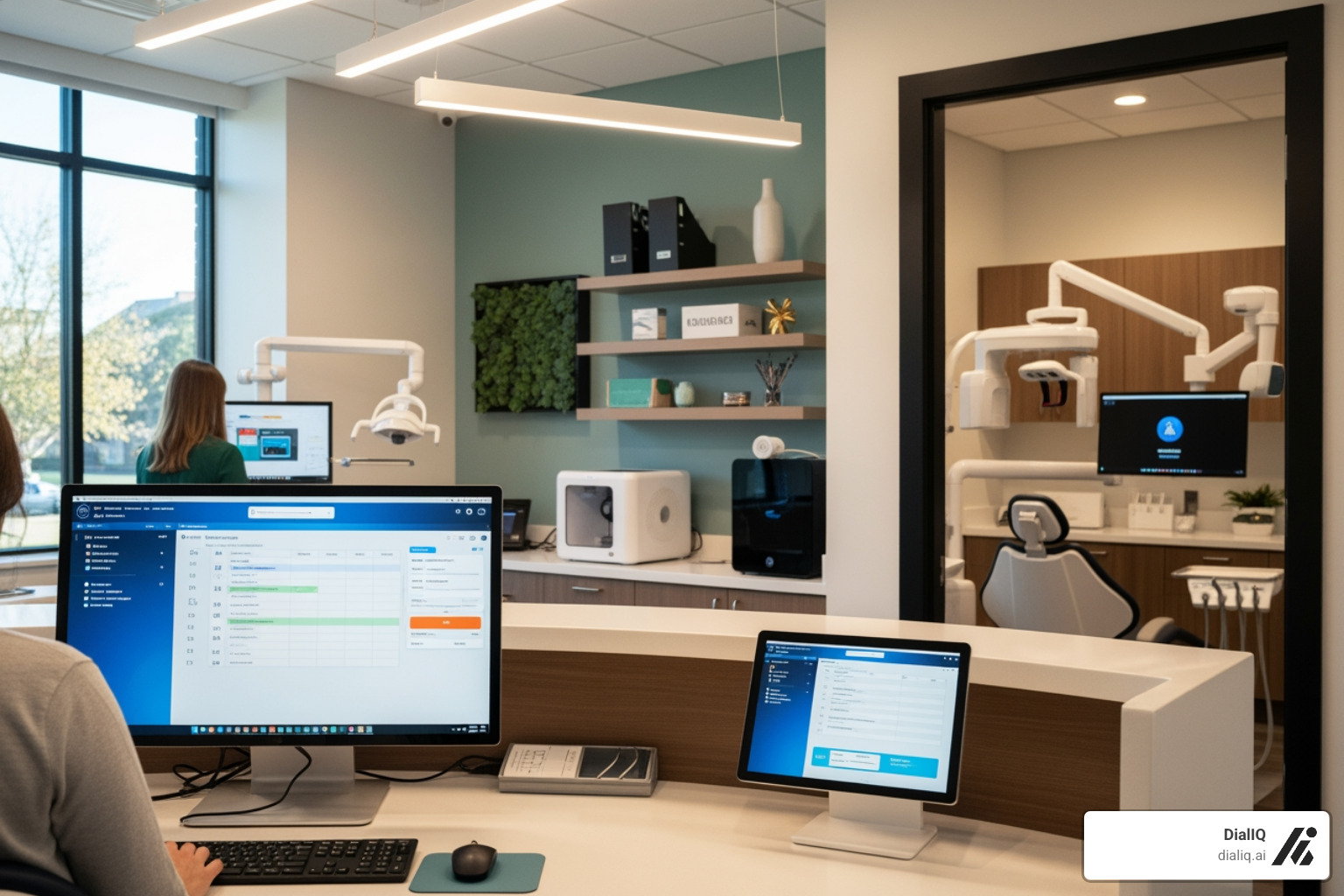
The most impactful areas for automation typically fall into three categories: front office operations, clinical support, and overall business management. Each area presents unique opportunities to save time, reduce errors, and improve both staff and patient satisfaction. Leading dental practices highlight these as essential functions to automate, emphasizing the transformative power of such changes.
Streamlining the Front Desk with Dental Practice Automation
The front desk is often the first and last point of contact for our patients, and it's a hub of administrative activity. Automating these functions can significantly reduce the load on our staff and improve efficiency.
One of the most impactful areas is appointment scheduling. Automated appointment scheduling software allows patients to book their own appointments 24/7, reducing phone traffic and freeing up our front desk team. This not only offers convenience to patients but also ensures our schedules are optimized. We can explore automatic appointment booking to see how this works in practice.
Patient intake forms are another prime candidate for automation. Electronic forms enable patients to fill out most of their paperwork before ever setting foot in the office, streamlining patient intake and thinning out lines at the reception desk. This saves patients time and gives our staff more time to prepare for their arrival.
Beyond scheduling and intake, automation can revolutionize insurance verification, billing, and payments. Automated systems can verify insurance in real-time, submit claims electronically, and even process payments efficiently, reducing manual paperwork and speeding up reimbursement. Finally, targeted recall campaigns can be automated, ensuring patients are regularly reminded for their check-ups, maintaining a consistent patient flow.
Automating Administrative and Compliance Tasks
Compliance is non-negotiable in dentistry, but managing it manually can be a colossal drain on resources. Dental practice automation offers robust solutions for these critical, yet often tedious, tasks.
Imagine digital task systems that provide checklists for daily compliance activities like sterilizer tests, equipment maintenance, and line flushing. These systems can remind responsible staff members, track completion, and generate audit-ready logs automatically. This not only ensures adherence to regulatory requirements but also significantly reduces the risk of human error, which can have serious consequences.
Moreover, automation can extend to tracking staff certifications and Continuing Professional Development (CPD) credits, ensuring that all team members maintain their licenses and are up-to-date with required training. Automated alerts can notify us of upcoming expirations, preventing any last-minute scramble. Lab work monitoring—tracking the status of crowns, aligners, and other prosthetics—can also be automated, providing real-time updates and improving workflow. These automations streamline end-of-month reports and basic billing entries. For more on how to capture leads and streamline these processes, consider automated customer intake.
Enhancing Business and Clinical Operations
Beyond the front desk and compliance, automation can deeply impact the core business and clinical aspects of our dental practices.
Inventory management, for instance, can be transformed. Automated systems can monitor supply levels, track usage, and even trigger reorders when stock runs low, preventing those frantic last-minute supply runs. This optimizes our spending and ensures we always have what we need.
Financial reporting, often a time-consuming manual process, can be automated to provide real-time insights into our practice's health. Automated reports on production, collections, and patient demographics allow us to make informed business decisions quickly, shifting conversations from "we should look into this" to "here's what we do next."
In the clinical field, automation can assist with aspects like clinical documentation, though direct patient care will always remain in human hands. More subtly, AI can analyze data to suggest optimal scheduling patterns, maximizing chair time and minimizing patient wait times. For instance, AI can suggest how to cluster procedures or the best times for high-production treatments. This ensures our schedules are not just full, but strategically optimized for productivity and patient flow. We can learn more about how to automate appointment scheduling to implement these strategies.
The AI Revolution: Smart Automation for Dental Practices
The landscape of dental practice automation is rapidly evolving, with AI at the forefront of this revolution. Not all automation is created equal. While traditional automation handles rule-based, repetitive tasks, AI-powered automation goes a significant step further.
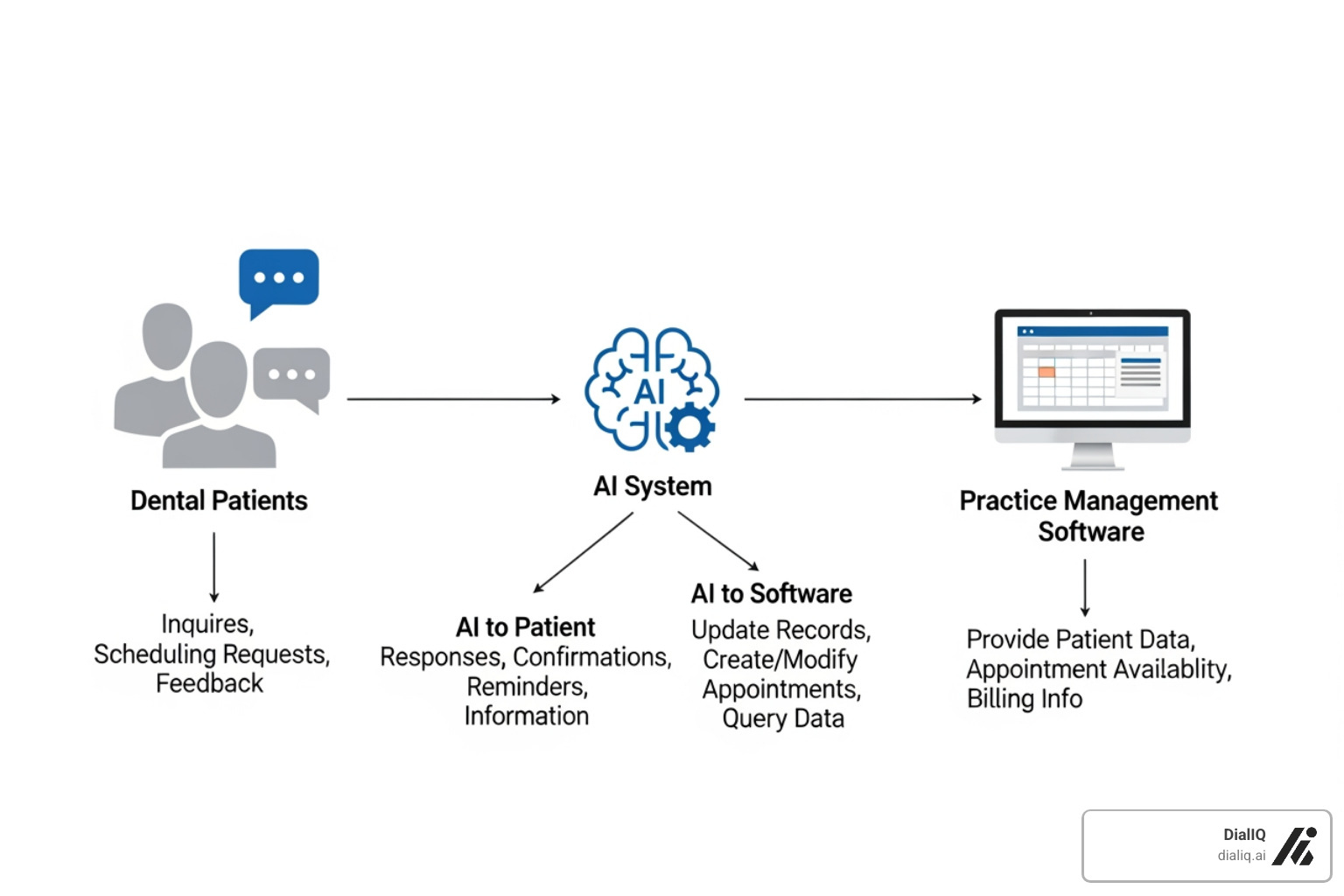
Traditional automation is excellent for tasks like sending out appointment reminders or processing standard forms. It follows a set of pre-defined rules. AI-powered automation, however, uses natural language processing (NLP), predictive analysis, and machine learning to understand context, learn from interactions, and make intelligent decisions. This means it can handle more complex, nuanced tasks that traditionally required human judgment. It's the difference between a simple "If X, then Y" and an intelligent system that can interpret, adapt, and even anticipate needs. For a comprehensive understanding, consult our complete guide to AI phone agents.
The Role of AI in Patient Communication
Patient communication is an area where AI truly shines. Unlike traditional IVR systems that often frustrate callers with rigid menus, AI voice agents engage in natural, conversational interactions.
| Feature | Traditional IVR | AI Voice Agent |
|---|---|---|
| Interaction Style | Menu-driven, rigid, often frustrating | Conversational, natural, context-aware |
| Availability | Limited to office hours or basic routing | 24/7, handles calls simultaneously |
| Complexity | Handles simple, pre-defined questions | Understands complex queries, intent detection |
| Personalization | Minimal, generic responses | Highly personalized based on patient context |
| Integration | Basic call routing, limited data sync | Deep integration with PMS, real-time updates |
| Multilingual | Often single language or limited options | Can be programmed for multiple languages |
An AI voice agent offers personalized engagement, detecting the patient's intent even with varied phrasing. This means 24/7 support that truly understands what the patient needs, whether it's booking an appointment, asking about services, or inquiring about insurance. With multilingual capabilities, AI can cater to diverse patient communities, ensuring no one feels left out. This sophisticated approach to communication improves patient satisfaction and engagement significantly. Learn more about AI voice agents and the power of intent detection AI.
What is an AI Receptionist and How Does it Work?
An AI receptionist is a smart computer helper designed specifically for dental offices. It's not a generic chatbot; it's purpose-built, custom AI that acts as an extension of your team. Its core functionalities directly address the pain points of a busy front desk.
Primarily, an AI receptionist excels at answering calls—all of them, simultaneously, 24/7. This eliminates busy signals and ensures every patient inquiry is captured, regardless of when it comes in. It can schedule appointments by checking real-time availability in your practice management system, confirming the booking, and sending automated reminders. This frees up your human team to focus on in-office patients and more complex tasks.
Beyond scheduling, it handles frequently asked questions (FAQs) about office hours, accepted insurance, services offered, and directions. If a call is complex or requires human intervention, the AI can intelligently perform call routing, transferring the patient to the appropriate staff member or taking a detailed message for follow-up. Crucially, it can even follow up on missed calls with a text, ensuring no potential patient falls through the cracks. This comprehensive approach is detailed in our complete guide to AI-powered receptionists, and you can explore the best AI phone systems for dental practices to see specific solutions.
Your Roadmap to Implementation: Steps, Costs, and Considerations
Implementing dental practice automation is a strategic investment, and a well-planned roadmap is essential for success. It begins with a thorough needs assessment, understanding where your current bottlenecks lie. Then comes careful software selection, choosing tools that align with your practice's unique requirements. Comprehensive staff training is vital to ensure smooth adoption, followed by seamless integration with your existing Practice Management System (PMS). Finally, robust data security and HIPAA compliance must be at the forefront of every decision. For a detailed blueprint, check out our AI receptionist implementation checklist.
Essential Steps for a Smooth Transition
A successful transition to automation isn't about flipping a switch; it's a methodical process.
- Identify Bottlenecks: Pinpoint the areas where your team spends the most time on repetitive tasks or where errors frequently occur. These are your prime candidates for automation.
- Set Clear Goals: What do you hope to achieve? Reduced no-shows, faster patient intake, improved staff satisfaction? Quantifiable goals will help measure success.
- Choose the Right Software: Select solutions that are purpose-built for dental practices, offer robust features, and integrate well with your existing systems. Avoid generic tools that might not understand the nuances of dental workflows.
- Plan a Parallel Run: For critical functions, consider running your old and new systems concurrently for a period. This allows your team to get comfortable with the new tools while having a safety net.
- Monitor and Adjust: Automation is not a "set it and forget it" solution. Regularly review performance metrics, gather feedback from your team, and make adjustments as needed to optimize efficiency.
The goal is to improve our team's capabilities, not diminish them. By automating repetitive tasks, staff can be re-focused on patient interaction. This allows our team members to focus on what truly matters – delivering quality patient care.
Leveraging Data with Dental Practice Automation
One of the often-underestimated benefits of dental practice automation is its ability to generate and analyze data, providing us with actionable insights that were previously unavailable or too time-consuming to extract.
Automated systems track every interaction, every appointment, every payment, and every communication. This wealth of data can be transformed into clear, concise performance tracking. We can set up Key Performance Indicator (KPI) dashboards that show us, at a glance, how our practice is performing in areas like appointment confirmation rates, patient acquisition, treatment acceptance, and revenue cycles.
AI phone analytics, for example, can track, measure, and optimize call performance, identifying peak call times, common patient inquiries, and even conversion rates from calls. This allows us to understand exactly where our practice is excelling and where there might be "production holes" in our schedule that need filling. By understanding our call performance metrics, we can make data-driven decisions to improve patient engagement and practice profitability. This shift from gut feelings to data-backed decisions is a powerful advantage in today's competitive landscape.
Potential Challenges and ROI
While the benefits are clear, we must also acknowledge potential challenges when adopting AI and automation in a dental practice.
One significant hurdle can be integration complexity. Ensuring that new automation software seamlessly communicates with existing Practice Management Systems (PMS) requires careful planning and often technical expertise. Another factor is staff resistance to change. Our team members might be apprehensive about new technologies, fearing job displacement or a steep learning curve. Open communication, comprehensive training, and emphasizing how automation improves their roles are crucial here.
Data privacy and HIPAA compliance are paramount. Any automation software handling patient information must adhere to the strictest security protocols. We must ensure our chosen solutions are fully compliant to protect sensitive patient data.
Finally, there are the cost implications. While automation promises cost savings, there's an initial investment. Calculating the Return on Investment (ROI) is essential. This isn't always straightforward, as ROI includes not only direct financial savings but also improved patient satisfaction, reduced staff burnout, and improved practice reputation. We can compare AI receptionist solutions to understand the nuances of various offerings and their cost-effectiveness.
Frequently Asked Questions about Dental Practice Automation
We understand that adopting new technologies like dental practice automation often comes with questions. Here, we address some of the most common concerns we hear from dental professionals.
Will automation replace my front desk staff?
This is perhaps the most common question we encounter, and the answer is a resounding no. Automation, especially AI, is designed to improve the roles of our front desk staff, not replace them. Think of it as providing your team with an incredibly efficient, tireless assistant.
By automating repetitive, time-consuming tasks like answering routine phone calls, scheduling basic appointments, and sending reminders, we free up our human staff to focus on high-value interactions. This means they can dedicate more time to greeting patients warmly, addressing complex patient concerns, providing personalized care, and building stronger relationships. Automation reduces staff stress and allows them to focus on in-office patient care, which significantly improves job satisfaction and patient experience. Our team members can become patient advocates and relationship builders, rather than being bogged down by administrative minutiae.
How does automation software integrate with my existing Practice Management System (PMS)?
Seamless integration is crucial for effective dental practice automation. Most modern automation solutions are designed to integrate with leading dental Practice Management Systems (PMS) like Dentrix, Eaglesoft, and Open Dental.
Integration typically occurs in a few ways:
- Direct API Integration: Many solutions offer Application Programming Interface (API) connections, allowing the automation software to directly "talk" to your PMS. This enables two-way data flow, meaning that an appointment booked by an AI receptionist, for example, is automatically updated in your PMS schedule, and patient information can be pulled directly from your PMS for personalized communication.
- Third-Party Integrators (e.g., Zapier): For systems that don't have direct API connections, platforms like Zapier can act as a bridge, connecting thousands of different applications. This allows us to create custom workflows, ensuring that data flows smoothly between our automation tools and our PMS.
The goal is to create a connected ecosystem where all your systems work together harmoniously, eliminating manual data entry and ensuring real-time updates across your practice. You can learn more about SMS & Voice API integration for these seamless connections.
Is implementing an AI receptionist expensive?
The cost of implementing an AI receptionist is a key consideration, but it's important to view it as an investment with a significant Return on Investment (ROI), rather than just an expense.
While there is an initial setup and ongoing monthly fee, comparing this to the cost of a human receptionist reveals substantial savings. A human receptionist requires a salary, benefits, sick days, vacation time, and often overtime. An AI receptionist, however, works 24/7 without breaks, sick days, or benefits. This means consistent, round-the-clock coverage for a predictable monthly fee.
AI receptionists can reduce costs by decreasing the need for additional staff members, especially for practices experiencing high call volumes or looking to expand their hours. The ROI comes from various factors: never missing a potential patient call, significantly reducing no-shows through automated reminders, freeing up human staff for higher-value tasks, and improving patient satisfaction leading to better retention. For a detailed breakdown, we encourage you to consult our AI call handling service pricing guide. The long-term financial benefits often far outweigh the initial investment, making it a highly cost-effective solution for modern dental practices.
Conclusion: Future-Proof Your Practice Today
The journey of dental practice automation is more than just adopting new technology; it's about strategically rejuvenating our businesses, enhancing patient care, and empowering our teams. In a competitive and changing healthcare landscape, embracing automation and AI is no longer a luxury but a necessity for staying ahead.
By automating repetitive tasks, we open up unparalleled efficiencies, reduce costs, and minimize human error. We lift the patient experience through 24/7 accessibility, personalized communication, and streamlined processes. Most importantly, we free our dedicated dental teams from administrative burdens, allowing them to focus on what they do best: delivering exceptional, compassionate patient care.
The long-term advantages are clear: increased profitability, higher staff satisfaction, improved compliance, and a practice that is resilient, responsive, and ready for the future. We believe that with purpose-built, custom AI solutions, every call can be answered, every appointment scheduled, and every opportunity captured.
It’s time to move beyond the drill and accept the power of smart automation. Find how an AI receptionist can transform your practice today.