The Service Business Revolution Happening Right Now
AI for service businesses is changing how companies handle customer calls, schedule appointments, and manage operations. Here's what you need to know:
Key Applications:
- 24/7 Call Answering - Never miss a customer inquiry, even after hours
- Automated Appointment Scheduling - Book clients instantly without staff intervention
- Intelligent Call Routing - Direct customers to the right person or department
- Lead Qualification - Capture and prioritize prospects automatically
- Cost Reduction - Replace or supplement full-time receptionists at a fraction of the cost
Primary Benefits:
- Capture every lead (no more missed calls)
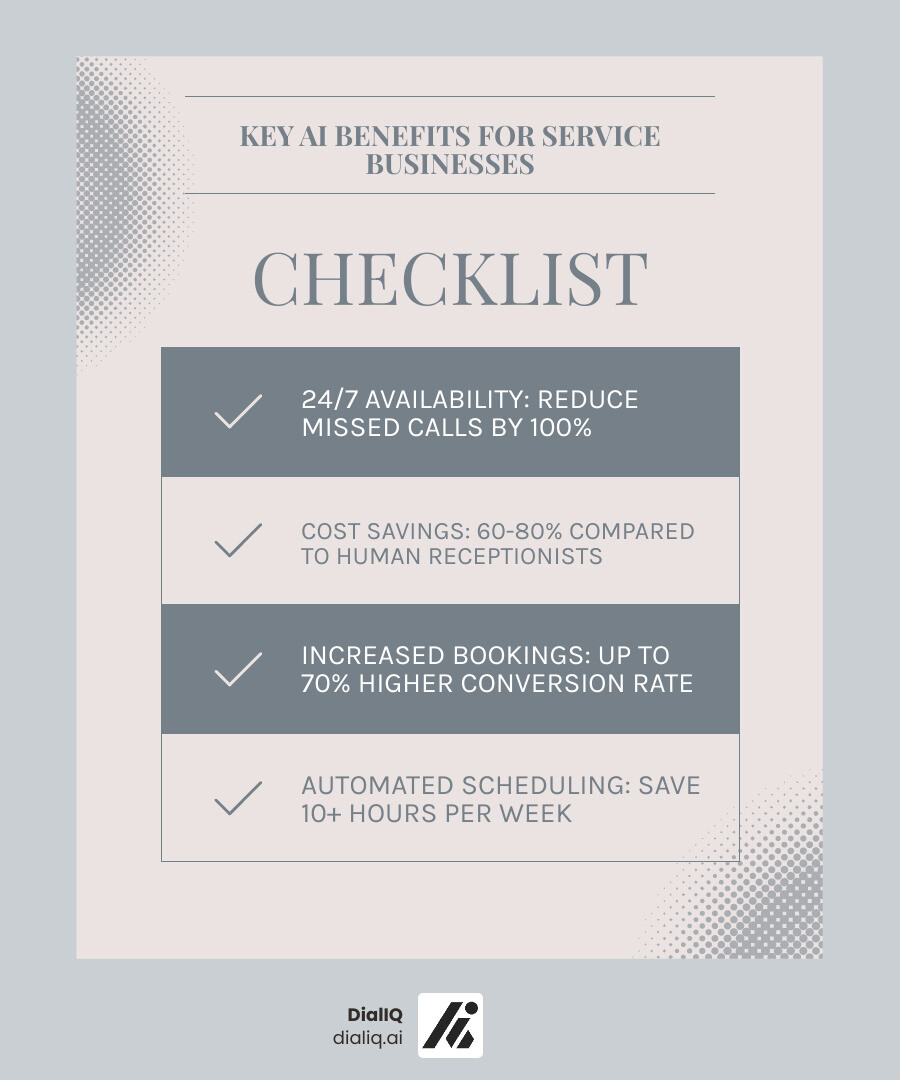
- Reduce staffing costs by 60-80%
- Improve customer satisfaction with instant responses
- Free up your team to focus on billable work
- Scale operations without scaling headcount
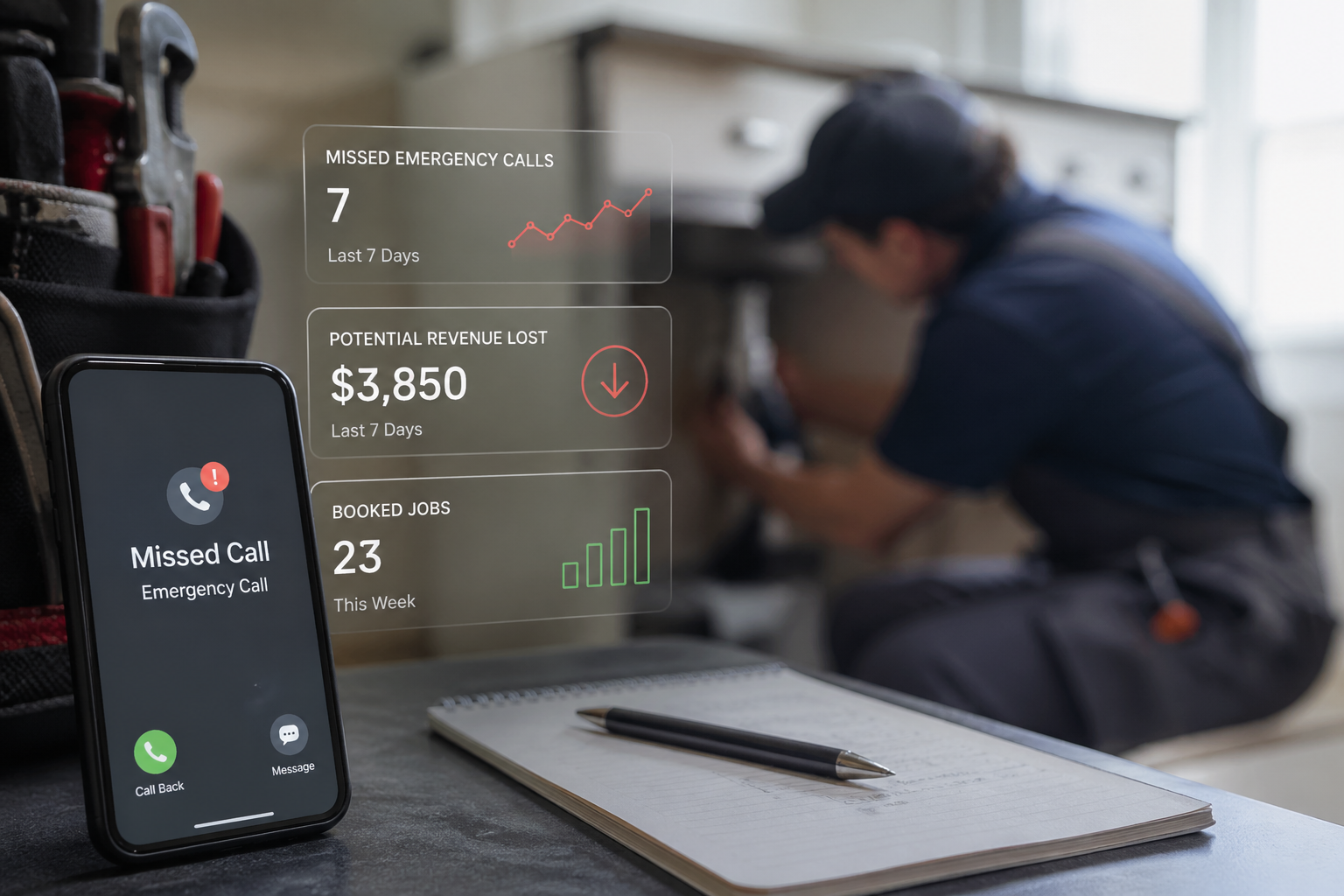
If you run a service business, you already know the pain. Calls pile up during busy hours. After-hours inquiries go to voicemail. Your team juggles phones while trying to complete actual work. Customers get frustrated waiting on hold.
The good news? Over 80% of companies are now integrating some form of artificial intelligence into their business strategy, and the technology has become remarkably accessible for small businesses.
This isn't about replacing your team. It's about giving them superpowers.
I'm Shaunak, and I'm building DialIQ—an AI receptionist that answers every business call 24/7 for service businesses across 40+ industries. I've seen how AI for service businesses turns missed opportunities into booked appointments and overwhelmed staff into productive teams.
What is AI as a Service (AIaaS) and How Does It Work?
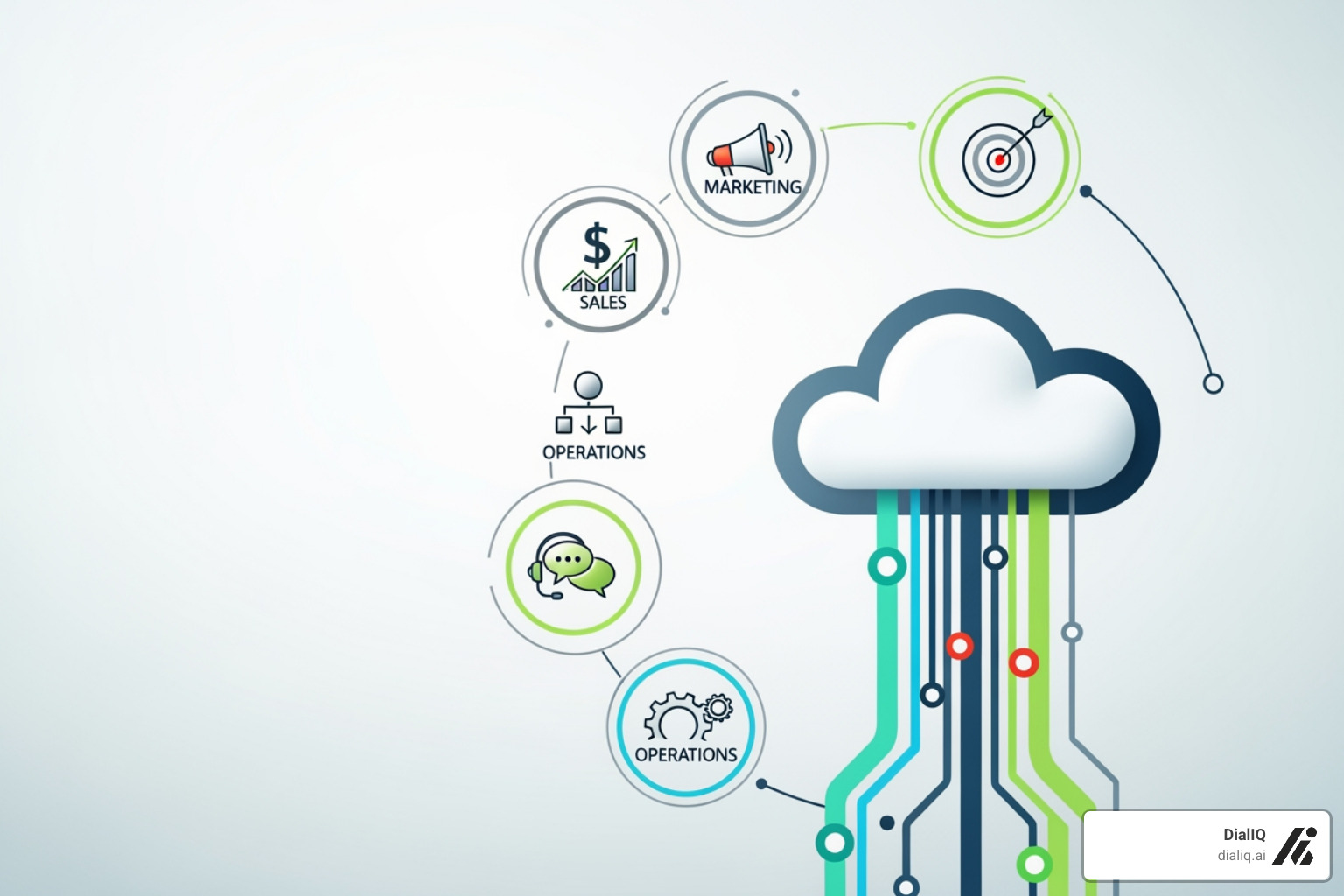
Imagine needing a powerful supercomputer for a few hours a day but not wanting to buy one or hire a team to maintain it. That's essentially what AI as a Service (AIaaS) offers us. It's a cloud-based model where we can access sophisticated artificial intelligence tools and capabilities over the internet, typically on a subscription or pay-as-you-go basis.
Instead of building complex AI systems from scratch, which requires significant upfront investment in hardware, software, and specialized talent, AIaaS allows us to "rent" these capabilities. We simply integrate the AI services into our existing workflows, and the provider handles all the underlying infrastructure, maintenance, and updates. This democratizes AI, making it accessible even for small and medium-sized service businesses that might not have the budget or in-house technical expertise for full-scale AI development. The scalability of AIaaS means we can easily ramp up or down our AI usage as our business needs change, without worrying about expensive setups. You can learn more about what AI services are and how they function.
Types of AI Solutions for Businesses
The world of AIaaS is vast, offering a range of specialized solutions custom to different business needs. For service businesses, some of the most impactful types include:
- Machine Learning as a Service (MLaaS): This provides access to pre-built machine learning algorithms and models that can analyze data, identify patterns, and make predictions. For us, this means we can leverage powerful data analysis without becoming data scientists ourselves.
- Natural Language Processing (NLP): NLP is the magic behind computers understanding, interpreting, and generating human language. For service businesses, this is crucial for tasks like understanding customer inquiries via text or voice, summarizing conversations, and even generating human-like responses.
- AI Phone Agents / Conversational AI: These are AI systems designed to engage in natural, human-like conversations. Our AI voice agents, for example, can handle incoming calls, answer questions, and even book appointments, acting as an extension of our team. These AI Voice Agents are revolutionizing how customers interact with businesses.
- Predictive Analytics: By analyzing historical data, this AI solution can forecast future trends, anticipate customer needs, and even predict potential issues before they arise, allowing us to be proactive rather than reactive.
- Computer Vision: While perhaps less central to customer service, computer vision allows AI to "see" and interpret images and videos. This can be useful for tasks like quality control or asset monitoring in certain service industries.
The Primary Benefits of AI for Service Businesses
The appeal of AI for service businesses isn't just about cool technology; it's about tangible improvements to our bottom line and customer experience. Here’s how these solutions benefit us:
- Increased Efficiency and Cost Reduction: AI automates repetitive, time-consuming tasks that often tie up our human staff. Think about answering common questions, scheduling appointments, or routing calls. By offloading these to AI, we significantly reduce operational costs. In fact, an AI Receptionist vs. Human Receptionist: The Real Cost Comparison for SMBs often reveals substantial savings.
- 24/7 Availability: Our customers don't always operate on a 9-to-5 schedule. AI works around the clock, ensuring that every inquiry is captured and addressed immediately, regardless of time zones or holidays. This means we never miss a lead or a customer in need.
- Improved Customer Satisfaction: Instant responses, personalized interactions, and the ability to get answers quickly all contribute to happier customers. Companies that use personalization can generate as much as 40% more revenue, showcasing the direct impact of AI on customer loyalty and spending.
- Data-Driven Decision Making: AI analyzes vast amounts of data much faster and more accurately than humans. This gives us actionable insights into customer behavior, operational bottlenecks, and market trends, allowing us to make smarter, more strategic decisions.
- Capturing Every Lead: Missed calls are missed opportunities and lost revenue. AI ensures that every inbound contact is handled, qualified, and routed appropriately, effectively eliminating The Hidden Cost of Missed Calls: Why Your Business Needs an AI Receptionist. This means our sales pipeline stays full and our growth potential is maximized.
Core Applications of AI for Service Businesses
Now that we understand what AIaaS is and its overarching benefits, let's dive into the practical ways AI for service businesses is being applied today. This isn't theoretical; these are real-world use cases driving efficiency and revenue growth across various service sectors.
Changing Customer Service and Communication
Customer service is arguably where AI is making its most immediate and noticeable impact. We're moving beyond simple FAQs to genuinely intelligent interactions:
- AI Answering Services: These are virtual receptionists that handle incoming calls, texts, and chats. They can answer common questions, provide information, and even perform complex tasks like booking appointments or qualifying leads. Our AI Phone Answering Service is a prime example, ensuring no call goes unanswered.
- Automated Appointment Booking: AI can seamlessly integrate with our calendars to book appointments directly, sending confirmations and reminders. This frees up staff and provides customers with instant scheduling capabilities. Here's How to Automate Appointment Scheduling: A Step-by-Step Guide for SMBs.
- Intelligent Call Routing: Instead of a generic menu, AI can understand the caller's intent and direct them to the most appropriate department or even a specific human agent. This reduces transfer times and improves first-call resolution. Our AI Call Routing ensures customers get to the right place quickly.
- Lead Qualification: AI can interact with potential leads to gather essential information, determine their needs, and assess their readiness to purchase, effectively pre-qualifying them before a human agent steps in. Find The Ultimate AI Lead Qualification System for Small Businesses.
- Handling Call Surges: During peak times, emergencies, or seasonal rushes, AI can absorb a massive volume of inquiries, ensuring that every customer is addressed without overwhelming our human team. Just ask Roofing Companies: How AI Handles Storm Season Call Surges.
Streamlining Operations and Boosting Productivity
Beyond customer interactions, AI is a powerful tool for optimizing our internal operations:
- Automating Repetitive Tasks: From data entry to generating routine reports, AI can handle tasks that are structured and repetitive, eliminating human error and freeing up our team for more strategic work.
- Data Entry and Reporting: AI can automatically extract information from documents, emails, and conversations, populating our systems and generating comprehensive reports. This includes valuable insights from calls, as highlighted by AI Phone Analytics: Track, Measure, Optimize Call Performance.
- Inventory Management: For service businesses that deal with parts or supplies, AI can forecast demand, optimize stock levels, and even automate reordering, preventing shortages or overstocking.
- Cybersecurity: AI plays a crucial role in protecting our data. It can monitor networks for anomalies, detect potential threats in real-time, and automate responses to cyber incidents, providing both preventative and reactive solutions.
- Scheduling and Calendar Management: AI can not only book appointments but also optimize complex schedules, manage technician routes, and ensure efficient resource allocation. This is particularly valuable for businesses like those in AI Receptionist for Home Services (HVAC, Plumbing, Roofing).
Enhancing Marketing and Sales
AI also gives us a significant edge in how we attract and convert customers:
- Personalized Recommendations: By analyzing customer behavior and preferences, AI can offer highly relevant product or service recommendations, increasing cross-selling and upselling opportunities.
- Targeted Advertising: AI-powered analytics help us understand our audience better, allowing us to create more precise and effective marketing campaigns that deliver a higher return on investment.
- Customer Trend Analysis: AI can identify emerging patterns in customer behavior and market demand, helping us adapt our offerings and strategies to stay ahead of the curve.
- Sentiment Analysis: This AI capability analyzes customer feedback from reviews, social media, and conversations to gauge their mood and satisfaction. Understanding customer Sentiment Analysis allows us to quickly address concerns and improve our services.
- Improving Marketing ROI: By optimizing targeting, personalizing content, and automating routine marketing tasks, AI helps us get more bang for our marketing buck, leading to better conversion rates and increased revenue.
Your Roadmap to AI Implementation
Starting on the AI journey for your service business might seem daunting, but with strategic planning, a phased approach, and team involvement, it's entirely achievable. Think of it as laying down a clear roadmap to success.
Step 1: Identifying Opportunities for AI
Before we jump into specific tools, we need to pinpoint where AI can bring the most value to our unique business. This involves asking ourselves some critical questions:
- Operational Inefficiencies: Where are our processes slow, error-prone, or resource-intensive? These are prime candidates for AI optimization.
- Repetitive Tasks: Which tasks do our employees perform over and over again? Data entry, routine customer inquiries, and basic scheduling are often perfect for AI automation.
- Freeing Up Employee Time: What are our team members doing that prevents them from focusing on more complex, value-generating work? AI can Reduce Phone Burden & Staff Burnout: AI Solution, allowing our experts to concentrate on what they do best.
- Areas Needing Quick, Data-Backed Answers: Where do we need instant access to information or rapid analysis to make decisions? AI excels at sifting through vast datasets quickly.
- Quality Control Scenarios: Are there areas where consistency or accuracy is paramount but difficult to maintain manually? AI can provide a level of precision and oversight that human efforts alone might miss. As the government's guide on effective use of AI suggests, effective AI use starts with a clear problem and useful data inputs.
Step 2: Getting Started with AI for Service Businesses
Once we've identified our opportunities, it's time to take concrete steps toward implementation:
- Define Clear Goals and Set Measurable KPIs: What do we want to achieve with AI? Is it reducing call wait times by 50%? Increasing booking rates by 20%? Having specific, measurable goals allows us to track progress and prove ROI.
- Research AI Tools: The market is flooded with AI solutions. We need to find those that best fit our identified needs and integrate with our existing systems. A comprehensive resource like an AI Receptionist Complete 2025 Buyer's Guide can be invaluable here.
- Start with a Pilot Project: Don't try to transform everything at once. Pick one area, implement an AI solution on a small scale, and learn from the experience. This minimizes risk and allows for quick adjustments.
- Monitor Performance: Continuously track the KPIs we set. Is the AI meeting expectations? Where can it be improved?
- Scale Implementation: Based on the success and learnings from our pilot, we can gradually expand the AI's role and apply it to other areas of our business. This iterative approach is detailed in resources like The AI Reception Playbook: How to Implement, Optimize, and Scale AI Phone Coverage in Your Home Services Business.
Step 3: Best Practices for Implementing AI for service businesses
To ensure our AI implementation is successful and sustainable, we should follow these best practices:
- Integrate with Existing Systems: AI should be a seamless extension of our current tools, not another silo. Ensure that our AI solutions can connect with our CRM, scheduling software, and other critical platforms through CRM Integrations and APIs.
- Prepare Your Workforce: AI isn't about replacing people; it's about augmenting their capabilities. We need to communicate the benefits, retrain staff, and emphasize upskilling so our team can work effectively alongside AI.
- Ensure Data Security and Compliance: Protecting customer data is paramount. We must choose AI solutions that adhere to strict security protocols and comply with all relevant data privacy regulations. Read more about Compliance & Security: How AI Receptionists Protect Business Data.
- Foster a Culture of Innovation: Encourage our team to experiment with AI, provide feedback, and identify new ways to leverage the technology. This continuous improvement mindset is key to long-term success.
- Create Feedback Loops: AI learns best when it receives continuous feedback. Establish mechanisms for human oversight and correction to help our AI systems improve over time.
The Future is Now: Agentic AI and Upcoming Trends
The evolution of AI for service businesses isn't slowing down. We're on the cusp of even more profound changes, moving towards systems that are not just intelligent but also autonomous and proactive.
The Rise of Agentic AI in Customer Service
Traditionally, AI in customer service has acted as a support tool—answering questions, routing calls, or suggesting responses. However, a new frontier is emerging: Agentic AI. This refers to AI systems that possess memory, reasoning, and autonomy, allowing them to perform real-time decision-making and orchestrate entire customer journeys. As highlighted in Agentic AI Is the New Frontier in Customer Service Transformation, these AI agents can:
- Act as Autonomous Actors: They can observe customer data, analyze situations, plan a course of action, and execute tasks across various tools and platforms without constant human intervention.
- Orchestrate End-to-End Journeys: Instead of just handling one interaction, agentic AI can manage a customer's entire service process, from initial inquiry to resolution, even coordinating across different departments.
- Proactive Problem-Solving: Imagine an AI detecting a potential billing error before a customer even notices it, then autonomously investigating, coordinating fixes, and confirming resolution. This is the power of agentic AI.
- Pre-empting Issues and Self-healing Processes: The ultimate goal is for AI to anticipate problems and resolve them automatically, often before they impact the customer. This shifts customer service from a reactive cost center to a proactive value creator.
Future Trends in AIaaS and Customer Experience
Looking ahead, we can expect several exciting developments in AI for service businesses:
- Hyper-personalization: AI will deliver increasingly custom experiences, not just based on past interactions but also on real-time context, mood, and predictive analytics.
- Deeper Integration with IoT and Other Tech: AI will connect more seamlessly with smart devices, sensors, and other technologies, creating a more comprehensive and intelligent service ecosystem.
- Advanced NLP for More Natural Conversations: AI will become even better at understanding nuances in human language, making interactions with Conversational AI Receptionist systems indistinguishable from talking to a human.
- AI-Driven Coaching for Human Agents: AI will analyze human agent performance, identify areas for improvement, and provide personalized coaching and training, enhancing the skills of our human teams.
- The 2025 Communication Revolution: We're heading towards a future where AI reception is not just an option but a standard expectation in service businesses. This shift, described as The 2025 Home Services Communication Revolution: Why AI Reception is Becoming Table Stakes, will redefine how customers interact with service providers.
Overcoming Challenges in AI Adoption
While the future is bright, we must also acknowledge and address the challenges that come with AI adoption. Here are some common problems and how we can overcome them:
- Addressing Skill Gaps: Many leaders feel their teams lack the skills to handle AI. We can overcome this by investing in training and upskilling programs, focusing on how AI augments roles rather than replaces them.
- Managing Workforce Concerns: Employees often fear job displacement. Open communication, demonstrating how AI frees them for more engaging work, and involving them in the AI implementation process can build trust.
- Ensuring Trust and Reliability: Concerns about AI accuracy, especially with older training data, are valid. We must ensure our AI systems are trained on up-to-date, relevant, and trusted data, ideally integrated with our CRM and knowledge bases.
- Overcoming Investment Problems: While AIaaS makes AI affordable, initial investments in infrastructure or integration can still be a concern. Focusing on pilot projects with clear ROI can justify further investment.
Here’s a quick list of challenges and solutions:
- Challenge: Workforce Apprehension
- Solution: Transparent communication, upskilling initiatives, showcasing AI as an assistant.
- Challenge: Data Quality and Age
- Solution: Integrate AI with real-time CRM and knowledge bases, implement strong data governance.
- Challenge: Integration Complexity
- Solution: Choose AIaaS providers with robust API capabilities and proven integration records.
- Challenge: Measuring ROI
- Solution: Define clear KPIs from the start, conduct pilot projects, and continuously monitor performance.
- Challenge: Ethical Concerns & Bias
- Solution: Implement ethical AI guidelines, regularly audit AI decisions, and maintain human oversight.
Frequently Asked Questions about AI in Service Businesses
We often hear common questions from service business owners considering AI. Let's address some of them:
Can small businesses really afford AI?
Absolutely! This is one of the biggest misconceptions we encounter. Thanks to the AIaaS model, advanced AI is no longer exclusive to large corporations. Instead of large upfront investments, we pay for AI services on a subscription or usage basis, much like cloud storage or software. This makes it incredibly cost-effective, especially when compared to the expense of hiring full-time staff. We can use our ROI of AI Receptionist Calculator to see just how quickly the investment pays for itself. For many service businesses, an AI solution can be significantly cheaper than a human receptionist while offering 24/7 coverage.
What happens if the AI can't answer a customer's question?
This is a very common and important question. Modern AI systems are designed with seamless escalation protocols. If an AI encounters a query it can't handle, if a customer expresses frustration, or if the situation requires human empathy or complex problem-solving, the AI can immediately and smoothly transfer the customer to a human agent. Our Emergency Escalation Protocols ensure that critical calls always reach the right human. This creates a powerful hybrid human-AI model where AI handles the routine, freeing up our human team for the nuanced and complex interactions. Plus, AI learns from these interactions, continually improving its ability to handle future queries. The goal is always to support our team, not replace them entirely.
How does AI integrate with my existing business tools?
Integration is key to a successful AI strategy. Most reputable AIaaS providers offer robust API (Application Programming Interface) integrations that allow their AI systems to connect directly with our existing business tools. This means our CRM (Customer Relationship Management) software, scheduling applications, and other operational systems can sync seamlessly with the AI. For example, our AI can automatically update customer records in the CRM, book appointments directly into our scheduling software, and even retrieve customer history to provide personalized service. These Telephony Integrations and bidirectional data flows ensure that all information is centralized and consistent, creating a unified view of our operations and customers. For specialized industries, this can include PIMS Integration for veterinary practices, ensuring every system works together.
Conclusion
The revolution of AI for service businesses is not just hype; it's a powerful, accessible reality that is fundamentally changing how we operate and serve our customers. From streamlining routine tasks and capturing every lead to enhancing customer satisfaction and boosting our bottom line, AI is proving to be an indispensable tool for growth and efficiency. It empowers our teams, improves our customer experiences, and allows us to scale our operations without scaling our headcount.
By understanding what AIaaS offers, identifying the right opportunities, and implementing solutions strategically, we can open up immense value. The future, with agentic AI and hyper-personalized customer experiences, is already here, and it's within our reach.
To start leveraging these benefits and transform your service business, explore purpose-built solutions from providers like DialIQ. We're here to help you steer this exciting new landscape and ensure your business thrives. Learn more about our AI Receptionist for Small Business.