Why AI for Small Business Matters Now More Than Ever
AI for small business is changing how companies operate, compete, and grow. Here's what you need to know:
- AI automates time-consuming tasks like answering calls, scheduling appointments, and managing customer inquiries
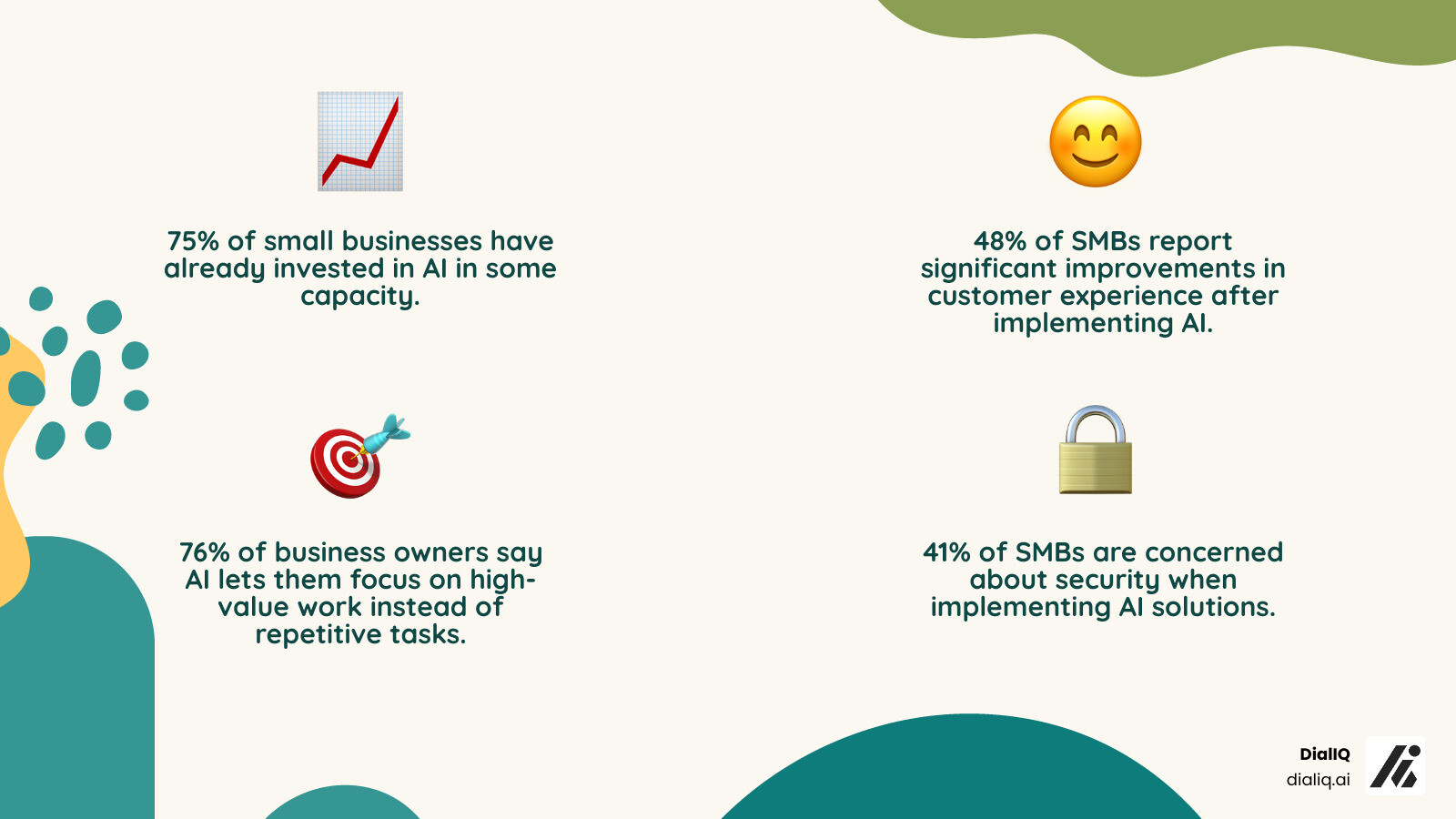
- 75% of small businesses have already invested in AI in some capacity
- 48% of SMBs report significant improvements in customer experience after implementing AI
- 76% of business owners say AI lets them focus on high-value work instead of repetitive tasks
- AI costs far less than traditional solutions - starting at $15-50/month versus $31,200 annually for a human receptionist
The numbers tell a clear story. Missing just five calls a week can cost your business $24,000 in lost revenue annually. Meanwhile, 62% of small business calls go unanswered, and 90% of customers say immediate responses are critical when they have questions.
But here's the good news: AI isn't just for big corporations anymore. Small businesses are using AI to level the playing field, save time, cut costs, and deliver better customer experiences than ever before.
I'm Shaunak, and I'm building DialIQ—an AI receptionist that answers every business call 24/7 across 40+ industries. I've seen how AI for small business transforms operations, turning missed opportunities into revenue and freeing owners to focus on growth.
Why AI is a Game-Changer for Your Business
In today's world, small businesses are constantly seeking ways to gain an edge. Artificial intelligence, once a futuristic concept, is now a practical and powerful tool accessible to businesses of all sizes. The earliest successful AI program was written in 1951, showing that while AI isn't new, recent technological advances have made it incredibly powerful and user-friendly. When we talk about AI for small business, we're referring to computer systems that can mimic human intelligence for tasks like visual perception, speech recognition, decision-making, and language translation.
The benefits of adopting AI are profound and directly impact your bottom line. More than half of small business leaders say AI tools are critical to their businesses’ success. Why? Because AI helps us achieve:
- Increased Efficiency: By automating mundane, repetitive tasks, AI frees up valuable human capital. This means our teams can focus on strategic initiatives and high-value work, leading to greater productivity. In fact, 76% of small business owners say AI allows them to focus on high-value tasks.
- Cost Reduction: Automation and optimized processes mean doing more with less. AI can significantly cut operational costs, making it a budget-friendly alternative to traditional solutions. Businesses using AI-powered virtual agents can cut customer service costs by up to 30%, while AI-driven automation can increase productivity by as much as 40%.
- Improved Customer Experience: AI enables us to offer personalized, instant, and consistent service, leading to higher customer satisfaction and loyalty. Research in 2020 by Aberdeen found that companies using AI capabilities achieve a 3.5 times greater annual increase in customer satisfaction rates.
- Better Decision-Making: AI analyzes vast amounts of data quickly, providing us with insights that inform smarter business strategies. From predicting sales trends to identifying market opportunities, AI helps us make data-driven choices.
- Growth Opportunities: With efficiency gains, cost savings, and improved customer satisfaction, AI directly contributes to business growth, helping us expand our market reach and develop new products or services.

Boost Your Customer Service
Customer service is often the first and most lasting impression a small business makes. AI can revolutionize this critical area, ensuring every customer interaction is positive and productive.
- 24/7 Availability: Imagine your business never missing a call, even outside of working hours. AI answering services act like a virtual receptionist, providing round-the-clock support. This ensures no missed opportunities, as 62% of calls to small businesses go unanswered, and up to 80% of callers won't leave a voicemail. An AI phone agent can be there to answer every time, preventing lost revenue.
- Instant Responses: Customers expect quick answers. AI-powered chatbots and virtual assistants can provide immediate responses to common queries, reducing wait times and improving satisfaction. This is crucial as 90% of customers say an immediate response is critical when they have a service question.
- Personalized Interactions: Modern AI can process customer data to offer personalized recommendations and support, making interactions feel more human and custom. AI improves customer service by anticipating needs and providing relevant information.
- Appointment Scheduling Automation: Say goodbye to manual scheduling headaches. AI can book, modify, and confirm appointments in real-time, integrating seamlessly with your existing calendars like Google Calendar or Outlook. This can significantly reduce no-shows and free up staff time. For a deeper dive into this, check out our guide on how to automate appointment scheduling.
- Multi-Language Support: Expand your reach with AI that can communicate in multiple languages. This is a game-changer for businesses in diverse communities or those looking to go global, making customers feel understood and valued.
AI call handling transforms the way we interact with customers, boosting satisfaction and loyalty. For more information on how AI can handle your calls efficiently, explore our Best AI Call Handling Services for SMBs 2026 Buyer's Guide and learn about the hidden cost of missed calls and why your business needs an AI receptionist.
Streamline Daily Operations and Administration
Small business owners wear many hats, and administrative tasks can quickly consume valuable time. AI for small business offers powerful solutions to automate and streamline these operations.
- Automating Repetitive Tasks: Many day-to-day tasks, such as data entry, invoice processing, and report generation, are ripe for AI automation. This frees up our team to focus on core business activities that require human creativity and judgment.
- Data Entry and Verification: AI tools can automate data extraction from documents and verify its accuracy, reducing errors and saving countless hours. Tools like Docuf.AI can handle this efficiently.
- Transcription Services: For businesses that rely on recorded meetings, calls, or interviews, AI transcription tools like Otter can convert audio to text quickly and accurately, making information searchable and shareable.
- Email Management: AI can help manage overflowing inboxes by automatically sorting, labeling, and categorizing messages. Tools like Levity can keep our communications organized and prioritize important emails.
- Schedule Management: AI-powered diary management tools like Motion and Akiflow can build optimum daily schedules, manage appointments, and send reminders, ensuring we stay organized and on track.
- Financial Analysis: AI can assist with accounting tasks, automate invoice creation, reconcile accounts, and provide financial insights, giving us a clearer picture of our business's health.
The efficiency gains from automating these tasks are significant. While a human receptionist incurs an average annual cost of $31,200, an AI receptionist solution can start as low as $19.99 per month, offering substantial cost savings. To understand the full cost comparison, explore our AI Receptionist vs. Human Receptionist: The Real Cost Comparison for SMBs.
Revolutionize Marketing and Sales
For small businesses, every marketing dollar and sales effort counts. AI can boost our marketing and sales strategies, making them more effective and personalized.
- Generative AI for Content Creation: Struggling with writer's block? Generative AI tools can create new original content for blogs, emails, social media posts, and other marketing materials, helping us maintain a consistent online presence. Tools like ChatGPT, Persado, Lex, CoWrite, Wordtune, Grammarly, NightCafe, and Craiyon. are readily available.
- Personalized Marketing Campaigns: AI can analyze customer data to identify preferences and behaviors, allowing us to create highly targeted and personalized marketing campaigns that resonate with individual customers. This leads to higher engagement and conversion rates.
- Lead Qualification: AI can act as a 24/7 sales assistant, engaging with potential leads, asking qualifying questions, and routing the most promising ones directly to our sales team. This ensures our sales efforts are focused on high-potential prospects. Learn more about how to build the ultimate AI lead qualification system for your small business.
- Social Media Management: AI tools can help schedule posts, analyze engagement, and even generate content for various social media platforms, ensuring our brand stays active and connected with our audience.
- SEO Optimization: AI can assist with keyword research, content optimization, and performance analysis, helping our website rank higher in search results and attract more organic traffic. SEO.ai is one such tool.
By leveraging AI for small business in marketing and sales, we can reach more customers, convert leads more effectively, and build stronger brand loyalty, all while optimizing our resources.
A Practical Guide to AI for Small Business Implementation
Implementing AI might sound daunting, but it doesn't have to be. For small businesses, a structured approach ensures we integrate AI effectively and realize its full potential.
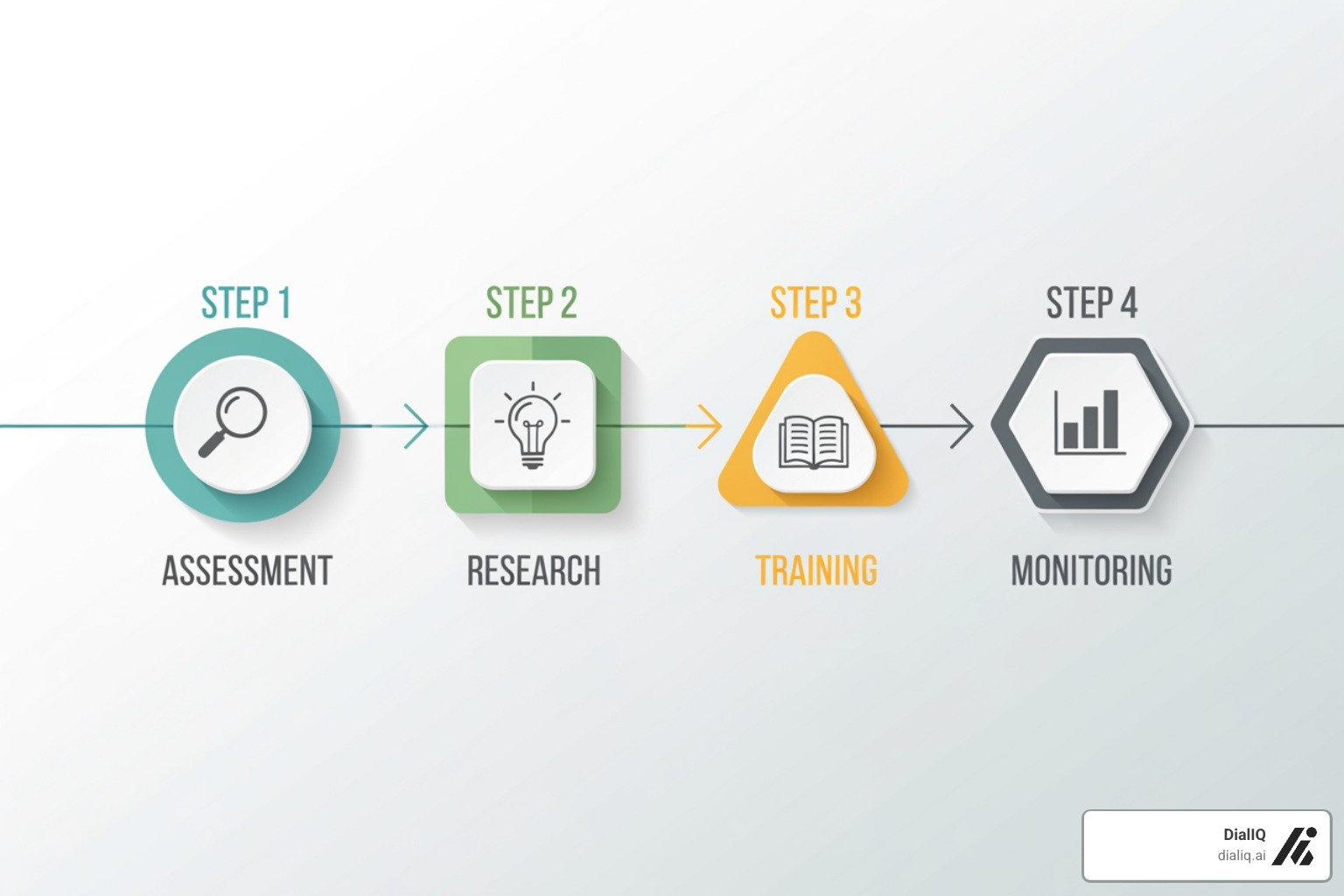
Here's a simple four-step process to build a foundation for AI success:
Step 1: Identify Key Areas for AI Integration
Before diving into tools, we need to understand where AI can make the biggest impact in our unique business. This involves a thorough self-assessment:
- Analyze Workflows: Map out our current operational processes. Where do we spend the most time on repetitive or manual tasks?
- Pinpoint Bottlenecks: Are there specific areas where work piles up, or processes slow down? AI can often alleviate these pressure points.
- Identify Time-Consuming Tasks: What tasks consume significant employee hours but don't necessarily require human creativity or complex decision-making? These are prime candidates for AI automation.
- Customer Service Pain Points: Are customers experiencing long wait times, inconsistent answers, or difficulty reaching us? AI can directly address these issues.
- Marketing Inefficiencies: Are our marketing efforts generic, or are we struggling to personalize campaigns and measure ROI? AI can bring precision to our outreach.
Consider what an AI phone system for SMBs can do compared to a traditional small business phone system. Identifying these key areas helps us focus our AI efforts where they will yield the greatest returns.
Step 2: Choose the Right AI Tools for Your Needs
With our target areas identified, the next step is to find the right AI solutions. The market is flooded with options, so choose wisely.
- Budget Considerations: AI tools come at various price points. We need to find solutions that offer the best value within our budget, often starting with free trials or entry-level plans.
- Scalability: As our business grows, our AI solutions should be able to scale with us without requiring a complete overhaul.
- Integration with Existing Software: Seamless integration with our current CRM, accounting software, or other business tools is crucial to avoid data silos and ensure smooth workflows. In the case of legacy tools or custom-built solutions, we may be able to use a customized API.
- Ease of Use: Small businesses often lack dedicated IT teams. User-friendly AI tools with intuitive interfaces are preferred to minimize training time and adoption problems.
- List of AI Tool Categories:
- Customer Service: AI Receptionists (like DialIQ), Chatbots (Freshchat, Happy Fox, Kustomer), AI Voice Agents. These can handle inquiries, provide instant support, and manage appointments. For a comprehensive overview, consult our AI Receptionist Complete 2026 Buyer's Guide.
- Marketing: Content Generation (ChatGPT, Grammarly), Analytics (Google Analytics with AI features), Personalized Campaign tools (Persado).
- Operations: Scheduling (Motion, Akiflow), Transcription (Otter), Data Entry (Bit.ai), Workspace collaboration (Google Workspace with Gemini).
- HR: Recruitment (Fetcher, Paradox, Workable, Freshteam), Onboarding automation.
Step 3: Prepare Your Team and Data
Technology is only as good as the people using it and the data it's fed. Preparing our team and data is paramount for successful AI adoption.
- Employee Training: It's vital to educate our employees on the use of AI tools. This includes operational basics, usage expectations, and understanding how AI augments their roles, rather than replaces them. Offering training sessions helps build confidence and ensures effective utilization.
- Data Readiness: AI thrives on data. We need to ensure our data is clean, organized, and accessible. This might involve auditing existing data, standardizing formats, and establishing clear data input protocols.
- Data Privacy Policies: With AI handling sensitive information, robust data privacy policies are non-negotiable. We must ensure compliance with regulations like the European Union’s General Data Protection Regulation (GDPR) and the California Consumer Privacy Act (CCPA).
- Setting Clear Usage Guidelines: Establish clear rules for how employees should interact with AI tools, especially regarding confidential information and external communications. This includes understanding what data can be input into AI systems and what requires human oversight.
By investing in our team's AI literacy and ensuring our data infrastructure is sound, we pave the way for a smooth and beneficial AI integration.
Navigating the Risks: Ensuring Secure and Ethical AI Use
While the benefits of AI for small business are compelling, it's crucial to approach its adoption with a clear understanding of the potential risks. Ignoring these can lead to significant problems, from data breaches to reputational damage.
Protecting Your Business and Customer Data
Data is the lifeblood of any modern business, and AI systems often require access to it. This naturally raises concerns about security.
- Data Privacy: We must be vigilant about how our data is used and stored by AI tools. This includes understanding the AI provider's data handling policies and ensuring they align with our privacy standards and legal obligations.
- Preventing Data Leaks: Avoid feeding sensitive data or proprietary information into AI systems unless we are absolutely sure of their security protocols and how that data will be used (or not used) for training. A significant concern is that AI sources content from the web, so there's a risk that AI-produced content could infringe on existing patents, copyrights, or trademarks.
- Phishing Awareness: AI can be used to generate sophisticated phishing campaigns. We need to educate our team to recognize and report these threats, as AI-written scams can be highly convincing.
- Anonymizing Data: Where possible, anonymize customer data before feeding it into AI systems to protect individual privacy.
- Vetting AI Providers: Not all AI tools are created equal. Thoroughly vet potential AI providers for their security measures, compliance certifications (like SOC 2), and data governance practices. It's concerning that 41% of SMBs using AI still consider security as one of the major concerns.
We are responsible for the data we entrust to AI. If AI is part of purchased software, the creators of that software are responsible for its use of AI. However, if using free AI tools, we must have another person review them to ensure they are used ethically, securely, and accurately represent the business. Consulting an attorney to ensure AI use is consistent with local laws and best business practices is also a wise step.
Maintaining Trust and Ethical Standards
Beyond security, ethical considerations and maintaining customer trust are paramount when using AI.
- Transparency with Customers: While not legally mandated in all regions, disclosing AI use is becoming an expected best practice. Customers appreciate knowing when they are interacting with AI versus a human. This builds trust and avoids potential backlash.
- Avoiding Bias in AI: AI systems learn from data, and if that data contains biases, the AI will reflect them. We need to monitor and review AI content and decisions to ensure they are fair, unbiased, and reflect our company's values.
- Aligning AI with Brand Values: AI-generated content or interactions should always align with our brand's tone, voice, and principles. Tools that recognize AI-generated content may flag it as spam or lacking genuine knowledge, potentially leading to customer resistance. A human should assess all AI-generated messages.
- Human Review of AI Content: Never blindly publish AI-generated content or rely solely on AI for critical decisions. A human should always review and refine AI outputs to ensure accuracy, quality, and ethical alignment.
- Customer Trust is Critical: The statistic that 68% of customers say advances in AI make it more important for companies to be trustworthy underscores the need for careful, ethical, and transparent AI implementation.
By prioritizing ethical AI use and data security, we can leverage the power of AI while safeguarding our reputation and fostering strong customer relationships.
The Future of AI and Available Resources
The landscape of AI for small business is evolving at a breathtaking pace, promising even more transformative capabilities. We're on the cusp of an era where AI will be an indispensable partner for small businesses, not just a tool.
How to get started with AI for small business
Getting started with AI doesn't require a computer science degree or a massive budget. Many resources are available to help small businesses dip their toes into the AI waters.
- Small Business B(AI)sics Initiative: The U.S. Chamber of Commerce Foundation, with support from Google, launched Small Business B(AI)sics—a national training initiative aimed at empowering 40,000 small businesses. This initiative provides local, in-person training, a digital AI learning hub with modules and webinars, and success stories.
- AI Training and Tools from Google: Google offers extensive resources to help small businesses. Their AI training and tools for small businesses include courses like "Make AI Work for You," which teaches how to delegate tasks, brainstorm solutions, and free up time. These courses are often free and available on platforms like YouTube.
- Free Workshops: Many organizations, including Google, offer free, in-person workshops across the country in partnership with local chambers of commerce. These workshops help create personalized AI plans for businesses.
- Online Courses: Platforms like Trailhead (from Salesforce) and Google's own offerings provide online modules and certificates to learn about AI, prompting essentials, and how to integrate AI into various business functions.
- Prompt Engineering Basics: Learning how to write effective prompts for generative AI tools is a skill that can open up immense value. Resources are available to teach us how to ask the right questions to get the best outputs from AI.
We believe that starting small and experimenting is key. As one small business owner advised, "I would just start one prompt at a time, see what happens." This iterative approach allows us to learn, adapt, and gradually integrate AI into our operations.
What are the future trends in AI for small business?
The future of AI in small business is incredibly promising. As new capabilities and technologies continue to emerge, these AI-powered tools can help revolutionize the way small businesses operate.
- Advanced Automation: Expect AI to automate even more complex tasks, moving beyond simple data entry to include more nuanced decision-making processes, further boosting efficiency.
- Deeper Data Insights: AI will provide even more sophisticated analytics, offering hyper-personalized insights into customer behavior, market trends, and operational performance, allowing for highly targeted strategies.
- Proactive Customer Service: AI will become more predictive, anticipating customer needs and issues before they arise, offering proactive support and solutions. This could mean AI reaching out to customers with relevant information or offers at just the right time.
- AI-Driven Product Development: Small businesses will increasingly use AI to analyze market gaps, identify customer preferences, and even assist in the design and iteration of new products and services.
- Increased Accessibility: As AI technology matures, it will become even more user-friendly and affordable, democratizing access for even the smallest businesses. Cloud-based Microsoft AI solutions and custom workflows will continue to make AI accessible and affordable.
The government also plays a role, with 85% of SMBs believing that the government must balance regulation and innovation in AI. This balance will be crucial for fostering a responsible yet dynamic AI ecosystem for small businesses.
Conclusion
The journey into AI for small business might seem vast, but it's a journey worth taking. We've explored how AI is not just a technological fad but a powerful, accessible partner that can significantly boost our bottom line. From revolutionizing customer service with 24/7 AI Receptionists to streamlining daily operations, enhancing marketing efforts, and providing invaluable data insights, AI empowers us to compete, grow, and thrive.
The benefits are clear: increased efficiency, substantial cost reductions, vastly improved customer experiences, and smarter decision-making. While navigating the risks of data security and ethical use is paramount, with careful planning and continuous learning, these challenges are manageable.
The future is bright, with AI promising even more advanced automation and deeper insights. By taking the first step—identifying needs, choosing the right tools, and preparing our teams—we can harness the transformative power of AI. It’s about leveraging technology to free ourselves from the mundane, allowing us to focus on innovation, creativity, and the human connections that truly define our businesses.
For service-based businesses like veterinary clinics, specialized tools like DialIQ's AI Veterinary Receptionist can transform front-desk operations and ensure no opportunity is missed. Accept AI today, and let's open up a new era of growth and success for our small businesses.